On Libertarian Factionalism, Our Critics, Conservative Associations and State Power

Featured Posts, History, Libertarian Theory
Share

The generation of libertarians seen in such outfits as SFL excites and encourages me. I especially approve its efforts to cleanse the movement of the type of bigotry that emerged after years of the libertarian movement’s circumstantial alliance with conservatives to battle against New Deal liberalism. Finally, young libertarians seem poised to differentiate themselves entirely from rightwing mythology and error.

I worry, however, that many of the young libertarians, particularly centered around the DC institutions, might lose sight of the importance of radical anti-statism. This all relates to something I can best explain by way of a little autobiography.

I was always a cosmopolitan libertarian. Although I had my origins on the right, I have favored gay marriage and open borders since I was in junior high in the mid-1990s. I have always disliked the notion that white upper middle class men were somehow the most persecuted minority. I have always seen law enforcement’s treatment of people of color as one of the greatest problems in American culture. I have, with varying degrees of intensity, long been sympathetic to such leftish concerns as feminism and the need for the poorest to be liberated from the state infrastructure that keeps them down.

There are many like me who in the 1990s tended to see our values most represented in institutions like CATO and Reason, and who were suspicious of the seemingly conservative tendencies of other libertarians, such as those associated with Ron Paul.

…

On Libertarian Factionalism, Our Critics, Conservative Associations and State Power Read Post »
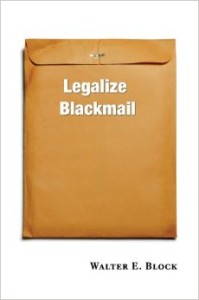
Walter Block Says Legalize Blackmail

Non-Fiction Reviews
Share

blackmailI was fortunate enough to get a PDF preview of Walter Block’s new book, Legalize Blackmail, before it was published, and today I was delighted to receive my hardcover copy in the mail.

The book is a collection of  Block’s essays on the subject of blackmail — specifically, why he believes it should be legal as a matter of libertarian principle — including rebuttals of many other scholars’ opinions. It’s the most thorough libertarian treatment of this subject that has ever been published or, I am  confident, ever will be. And because it’s from Block, it’s a great read besides.

As I say in a blurb on the book’s back cover: “If you want to understand the libertarian position on blackmail, read this book. If you’ve taken it for granted that we need laws against blackmail, Walter Block will challenge your assumptions with provocative arguments you’ll find difficult to refute.”

Order it here.

Walter Block Says Legalize Blackmail Read Post »

It’s coming! It’s coming!

Libertarian Theory
Share

ISFLC14_FB-cover_draft04All my feeds are filling up with a growing frenzy about the big event of the year, the International Students for Liberty Conference, Washington, D.C., February 14-16, 2014.

I’ve only been once but I completely get the frenzy. I stumbled in last year, having been brought to town for a different task (some recordings on business cycle theory). I saw that the ISFLC was happening and walked in.

Wow, amazed. A new world opened up to me. There were multitudes of students present, all learning about and celebrating the magnificence of human liberty. I had no intention to stay. Suddenly, nothing could pull me away.

This year is going to be bigger and better. I’m speaking. I’m fired up about that (thanks, Institute for Humane Studies!) but also happy that my own new company has a table and a fabulous party that we are throwing on Saturday  night. It’s for those who have signed up for Liberty.me at the presubscribe rate. You can pay now or pay at the event. I would love to see you.

This is only one of many private gatherings (of course I hope it is the hottest ticket of the event). I’m also happy that The Students for Liberty is able to work directly with Liberty.me in a cooperative venture to get students access to the libraries, forums, social networking, classes, and publishing opportunities that are the core of Liberty.me’s service. In many ways, it is the ideal digital home for this generation.

Here’s the thing. Most of the year, liberty-minded people tend to go around rather glumly, regretting the state of the world. This attitude is blasted away at the ISFLC. What you experience is hope, exuberance, love, optimism about the future. It is infectious. And there is great reason for it too: liberty is positioned to rule the world in our times as never before.

I’ve been in this liberty “movement” for a bit of time, and I can tell you that everything is changing. And changed. If you don’t believe it, come to the ISFLC and see for yourself.

See you at cocktail hour!

It’s coming! It’s coming! Read Post »

Habeas Corpus in America

History, Non-Fiction Reviews, Reviews
Share

Adobe Photoshop PDFReview of The Power of Habeas Corpus in America: From the King’s Prerogative to the War on Terror by Anthony Gregory. Cambridge University Press and the Independent Institute, 2013.

Anthony Gregory is a great friend of mine, and I am honored to have the opportunity to review briefly his splendid new book, Habeas Corpus in America.

A few comments about the book itself are in order before sojourning through the content. First, it is a beautiful volume. I suppose we can thank Cambridge University Press for that. The cover itself contains the text of Abraham Lincoln’s order to suspend habeas during the Civil War – a very nice visual touch. The forward is written by the erudite constitutional scholar Kevin Gutzman. The book is written in three parts: history of habeas corpus, application of habeas corpus after 9/11, and a section titled “Custody and Liberty” exploring the future of habeas. Multiple appendices then analyze various habeas cases, and the customary selected bibliography and historical term explanations follow. It is long, thorough, sweeping, and powerful – but also pretty expensive. I suppose we can thank Cambridge University Press for that as well.

Habeas corpus is generally understood as the legal right not to be detained arbitrarily by the government. It is considered a foundational principle of Western legal systems, even of natural law itself. Still, habeas corpus is widely misunderstood, especially on a historical level. Anthony Gregory’s work on the history of habeas corpus and its application in America levels a damning charge against the American federal government and challenges the reader to reconsider the common assumption that the federal government protects liberty by showing how and why they abridge this fundamental right.

…

Habeas Corpus in America Read Post »

The martyrdom of Aaron Swartz

Anti-Statism, IP Law, Technology
Share

A little over a year ago, a 26-year-old programmer and activist was murdered. His name was Aaron Swartz, and although he was found hanged in his Brooklyn apartment, and his death ruled a suicide, there is little question whose hands are stained with his blood. He was pursued mercilessly by a bullying prosecutor with a long track record of ruining the lives of brilliant (and perhaps naive) young men who didn’t play by the state’s rules. And he was betrayed by an educational institution that once prided itself on not playing by the rules, either.

Those are some of the heartbreaking and infuriating insights from a story in this month’s edition of Boston magazine about Aaron Swartz’ arrest and indictment, his father Bob’s attempts to extricate his son from the legal mess, and the relentless pressure by federal prosecutors to make an example of him. The punishment they sought for Aaron was draconian even by the feds’ standards: 13 felony counts under the Computer Fraud and Abuse Act (CFAA), with a possible prison term of 35 years, and a $1 million fine. Bank robbers and terrorists have received more lenient sentences. But U. S. Attorney Carmen Ortiz declared that Swartz’ prosecution would serve as a warning to other “hackers” about “stealing” from computers.

Aaron SwartzWhat did Swartz “steal”, exactly? Nothing. He downloaded files from JSTOR, an online archive for academic journals. Swartz used the network at MIT, where his father served as an adviser, under its “open access” policy, which included its subscription to JSTOR. Swartz had long held the view that scientific research should be freely available and not locked away behind a paywall. This wasn’t even the first time Swartz had performed such a download; in 2008 he grabbed 2.7 million documents from PACER, a federal court document system that usually charged for such access, even though they were public records. That attracted the FBI’s attention, but they found Swartz had committed no crime.

…

The martyrdom of Aaron Swartz Read Post »

Scroll to Top