Article: Healthcare Is Not a Human Right

Articles, Health Care, Libertarian Theory
Share

Of all the arguments favoring the coordination and control of the healthcare industry by the central planning agency of the state, the healthcare-is-a-human-right argument seems to be the most convincing one, even to those who may favor a free market approach to the problem of coordination of scarce health resources. How can we as a society possibly deny healthcare to someone in need? Shouldn’t the state assume that task?

Gabriel E. Vidal is the chief operating officer of a hospital system in the United States. He has a BA in politics, philosophy, and economics and an MBA in finance.

Read the Full Article by Gabriel E. Vidal

Afterwards, discuss it below.

Article: Healthcare Is Not a Human Right Read Post »

A Thought Experiment about Patents and Taxes

IP Law
Share

In Reducing the Cost of IP Law, I argued that one improvement to the patent system (short of abolition) would be to eliminate injunctions and provie for a compulsory licensing system. As I noted there, the compulsory licensing approach is not new. Some countries impose compulsory licensing on patentees who do not adequately “work” the patent. I discussed provisions in US patent law that do permit compulsory licenses already in some situations.1 I was reminded of this when discussing with some friends a comment to this blogpost, Pirated Software Could Bring Down Predator Drones. The commentor stated: “Just declare the IP a state secret. The market value is then zero, as the company cant sell it legally. Buy it from the company for 1 cent. Then classify the contract as top secret. If the company complains, send the people to jail or gitmo.”

As I noted in the previous posts, the feds have the authority to license third parties to manufacture patented articles, without patent infringement liability; this was threatened in the Cipro anthrax drug a couple years ago. The feds then have to pay “compensation” to the patent holder. Something similar happens if the some federal agency issues a “secrecy order” for military or other reasons for a pending patent.2

It occurs to me that the very notion of a compulsory license for IP can help to illustrate how IP is an obvious transfer of wealth. Consider: under current law, the state grants a patent monopoly to some applicant. Then, the state can declare a compulsory monopoly (or issue a secrecy order), and pay you some compensation for this “taking”. Obviously this payment comes from tax payers. So the IP step can be seen as just an intermediate step to justify transferring money from everyone else to the patentee. It’s as if you tell the state you have an idea and the state takes money from others and gives it to you. Come to think of it, this is exactly the idea behind proposals for tax-funded “innovation” awards–proposed even by some libertarians (!).3 The point is that even when the state does not issue the compulsory license, they are simply deputizing the patentee to go out and extort the money himself; it’s like taxation.

(Incidentally, in An Objectivist IP Argument for Taxation, I provide another argument for why IP could be used to justify taxes.)


  1. See Ciprofloxacin: the Dispute over Compulsory Licenses; Tom Jacobs, Bayer, U.S. Deal on Anthrax Drug, Motley Fool (Oct. 25, 2001); Compulsory Licensing in the US. See also Kinsella, Brazil and Compulsory Licenses, Mises Blog (June 8, 2007); Kinsella, Condemning Patents, Mises Blog (Feb. 27, 2005). 

  2. See The Secrecy Order Program in the United States Patent & Trademark Office; 35 USC ch. 17 §§ 181, 183. 

  3. See my posts Libertarian Favors $80 Billion Annual Tax-Funded “Medical Innovation Prize Fund”; “$30 Billion Taxfunded Innovation Contracts: The ‘Progressive-Libertarian’ Solution“; “Re: Patents and Utilitarian Thinking Redux: Stiglitz on using Prizes to Stimulate Innovation.” 

A Thought Experiment about Patents and Taxes Read Post »

The Instituto Ludwig von Mises Ecuador is born

(Austrian) Economics, Education, Libertarian Theory
Share

When I embarked upon the task of teaching Austrian Economics at USFQ (as ECN101 and with some concessions to the mainstream such  as teaching their flawed theories before attacking them) I couldn’t predict beforehand if I was going to find either resistance or support from my students and colleagues. I promise to tell TLS readers about the latter in another occasion. Of every class of 30-33 students for ECN101 I end up focusing on the 5-10 that are really into the material. We read a lot of Hoppe, Rothbard, Reisman, Dilorenzo, Kinsella and Block. Of course I tell my students that my class’ purpose is to show them a different point of view, since the “official” one can be found on the MSM of Ecuador and the U.S. and other classes even at USFQ (most PhD professors being either natural science types or liberal arts former hippies that support any soft form of socialism you can imagine there is.)

Of course of this 5-10 (per class, and I teach 3 classes per semester) maybe 2 or 3 become ardent libertarians and are encouraged to attend Mises University and FEE Seminars during the following summer. Last semester, I taught an “Advanced Libertarianism” seminar for the 12 best students from the past two years. Their enthusiasm being at a peak, they decided to do as Helio Beltrao and his libertarian cadre did in Brazil and create a LVMI-Ecuador think tank. My students Esteban Perez, Cindy Aguiar, Esteban Torres, Lizeth Torres, Alejandro Veintimilla, Pablo Mateus, Paul Riera and Lizeth Vasconez are the culprits: they are they driving force for LVMI-Ecuador. I’ll just say you better remember their names, they are very young but I bet they will make the headlines of libertarian and MSM publications later on.

The most exciting thing is that thanks to web 2.0 we can hold board meetings via Skype, promote our articles (60% of mises.ec being the translated Mises Daily articles) and events (this Wednesday we begin with “Cuba and the elephants” a thought-provoking documentary) via Facebook and keep our fixed costs to $40usd a year (for the .ec domain.)

In sum, today I want to share with you the official launch of www.mises.ec as the core service the Instituto Ludwig von Mises Ecuador has to offer the region and country in which it operates.

The Instituto Ludwig von Mises Ecuador is born Read Post »

Our Efficient, All-Volunteer Killers

Imperialism, War
Share

Steve Chapman extols the benefits of having an all-volunteer military force:

A few decades ago, the draft was a requirement for any major military undertaking. No one would have dreamed of fighting the Germans and Japanese, or the North Koreans and Chinese, without calling up young men for mandatory service. Not until the waning years of the Vietnam War did the nation elect to rely entirely on volunteers.

It was a controversial step, and one whose durability was very much in doubt. But in the intervening decades, the draft has gone from being indispensable to being unthinkable. Even the extraordinary demands of two difficult wars have not induced a reconsideration.

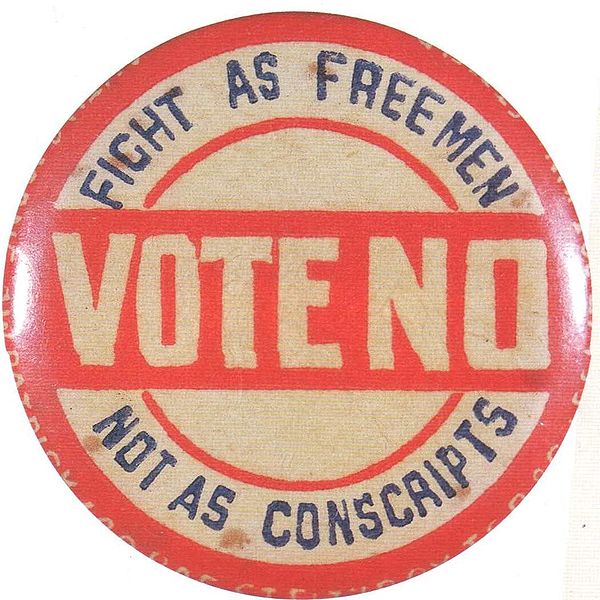
Anti-conscription badge from WWIEven the military’s leadership recognizes now that armies perform better when they’re filled with people who actually want to be there, and as Chapman points out, it’s a more efficient use of training dollars to spend them on Army careerists than on guys who’d rather be smoking pot and watching football.

If this is the extent of Chapman’s argument then I agree, but I’m not any more comforted by the fact that the military’s bombing and killing of poor people overseas are performed by people who actually want to do that sort of thing.  And he ignores the fact that young men must still notify the government of their whereabouts via Selective Service in case the draft is reinstated.  If the military really does not want conscripted men (and possibly women) among its ranks, why does the infrastructure for conscription still exist?

More dubious is Chapman’s concluding paragraph:

It was once a novel experiment: fielding a force to protect freedom without grossly violating freedom by dragooning young men to serve. But it’s worked so well we’ve almost forgotten there’s an alternative.

“Protect freedom” is a canard I expect from National Review, not a supposedly libertarian publication such as Reason.  Few if any all-volunteer forces have ever been used to protect Americans’ freedoms, even during the Revolutionary War (see volume 4 of Murray Rothbard’s Conceived in Liberty); and there isn’t a single military campaign undertaken in the past century that could be called a legitimate defense of freedom.  If one wishes to sing the praises of America’s efficient, all-volunteer killers, at least one shouldn’t pretend they exist for any reason other than to satisfy the imperialist aims of the Washington elite.

Our Efficient, All-Volunteer Killers Read Post »

Scroll to Top