
How Online Casino Licensing Works: A Measured Guide

Uncategorized
Share

Licensing is one of the details that sits behind every regulated online casino, and it is easy to see it as a badge rather than something with real meaning. A licence shows which authority supervises a platform and the rules it operates under, and it shapes matters such as the handling of funds, player protection, and the resolution of disputes. For a reader meeting the subject for the first time, understanding what a licence does, and does not, cover removes much of the guesswork. This article works through licensing in a measured way, from what a licence involves to how it can be checked and what it does not guarantee. The aim is a clear and neutral overview, keeping in mind that local rules and responsible participation always apply, and that content of this kind is intended for adults.

What a licence involves

A licence means a platform operates under the supervision of a named authority and must meet the obligations that come with it. These typically include how player funds are handled, how games are expected to work, the availability of responsible-play tools, and a route for resolving disputes. The core idea is that a licence describes a framework of rules rather than a single feature. What a specific licence involves is read from the platform’s own information and the authority behind it.

Which authority supervises a platform

Different platforms are licensed by different authorities, and each sets its own rules, so two licences are not necessarily equivalent. The supervising authority is usually named in a platform’s footer, often with a licence number. Reading which authority is involved, rather than assuming, is what gives the licence meaning, because the obligations follow the authority rather than the label.

How a licence can be checked

A licence is designed to be verifiable: the number or identifier a platform states can usually be confirmed against the authority’s own register. A match confirms the claim, while a mismatch or missing entry is a reason to look more closely. The register is the reliable source, and the check is short, turning a footer claim into something a reader can confirm rather than take on trust.

What a licence does not guarantee

A licence shows that a platform operates under a framework and its obligations, but it does not guarantee quality, service, or any particular outcome. Those depend on the platform’s own conduct and terms, which are read separately. Seeing a licence as a necessary detail rather than a complete verdict keeps it in proportion with the other things worth checking.

Licensing across different jurisdictions

Because each authority sets its own framework, a platform licensed in one jurisdiction operates under different obligations from one licensed elsewhere, even where both are reputable. Some frameworks sit within a wider regional context, such as the European Union, while others stand alone. This is why the specific authority matters more than a general sense that a platform is licensed, and why the particular framework is read from the platform’s information rather than assumed from the word alone.

Reading a licence in practice

In practice, reading a licence means finding the authority and number a platform states, usually in the footer, and confirming them against the authority’s register. It takes only a moment and tells a reader which rules apply. Doing this before depositing, rather than after a question arises, is the simplest way to put the licence to use, and it sits alongside reading the terms and the payment information.

Elements that stand out

When it comes to licensing, a few elements usually stand out:

  • Authority: the regulator named by the platform.
  • Identifier: the licence number, where it is given.
  • Scope: the obligations the licence involves.
  • Verification: confirming the licence against the register.
  • Responsibility: keeping participation measured and within local rules.

These elements shape the subject together, and reading them once gives a clearer picture than the licence label alone.

Licensing and consumer protection

Because a licence sets obligations such as the handling of funds and the resolution of disputes, it is closely tied to consumer protection, and in many cases to tax treatment as well. These follow the licence and the jurisdiction rather than the platform’s marketing. What applies is read from the platform’s information and official sources, and it can differ from one framework to another.

Responsible participation

Licensing supports responsible participation by requiring the tools that help manage play, such as deposit limits, time-outs, and self-exclusion, set in the account settings. These guide participation by a person’s own choices rather than changing the games, and support is available from independent organisations for anyone who needs it. A licensed framework is the setting in which these limits, decided in advance, do their work.

Viewing the topic with balance

A balanced view helps because coverage of licensing blends clear detail with a good deal of marketing about trust. General context can be found through dedicated sources, and as a starting point https://astropaykasinot.net/ can give a sense of the wider picture rather than a definitive account. When a reader treats a licence as a checkable detail to read and confirm rather than a badge to take on trust, the subject becomes easier to place in context.

A balanced view

Licensing is a practical, checkable part of a regulated platform: it names the authority, sets the obligations, and can be confirmed against a register, while leaving quality and conduct to be judged separately. The topic is guided by the authority, the identifier, the scope of obligations, and verification, alongside responsible participation with limits set in advance. When the subject is approached with patience and a measured attitude, and with local rules kept in mind, a licence becomes a clear and manageable part of the wider picture rather than a mark to take for granted.

How Online Casino Licensing Works: A Measured Guide Read Post »
Second Thoughts on Leoni, Hayek, Legislation, and Economic Calculation

Uncategorized
Share

My libertarianism has been fairly consistent over the years, especially since I morphed from Randian minarchist to Rothbardian anarchist around about 1989 or so (my last gasp in the minarchist camp was in a 1989 article; see Then and Now: From Randian Minarchist to Austro-Anarcho-Libertarian). I’ve been a pretty steady Rothbardian-Hoppean-Austrian anarcho-libertarian since then, for about 25 years. I try to develop my views carefully, systematically, precisely, and incrementally, building on, referencing, and integrating with previous things I’ve figured out. Sort of like the Kinsellian/libertarian common law.

On occasion I realize I made a mistake and try to regroup or redress it. Sometimes it’s just a matter of emphasis, like my de-emphasis in recent years of American constitutionalism (see Down with the Fourth of July and On Constitutional Sentimentalism)  and certain changes in emphasis in terminology (I now prefer  the term state to “government,” aggression to “coercion,” and refer to the object of ownership or property rights as a scarce resource rather than as “property,” primarily to avoid the equivocation that statists invariably engage in). I also think I slightly misstepped in my previous criticism of Rothbard on inalienability (see Inalienability and Punishment: A Reply to George Smith), though I stand by my criticism of Rothbard’s IP views and his debtor’s prison comments (I plan to elaborate on this soon). I’m also a little bit more gun-shy about engaging in armchair theorizing now than I was as a young pup. …

Second Thoughts on Leoni, Hayek, Legislation, and Economic Calculation Read Post »

Bureaucracy Kills: Catholic Shelter Housing ‘Too Many’ Homeless People

Nanny Statism, Statism, The Left, Uncategorized, Victimless Crimes
Share

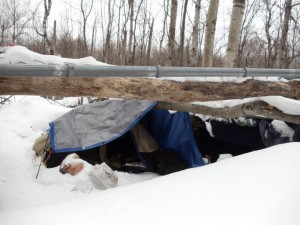
HOMELESS-WINTER-2There is libertarianism — with its debatable scope and definitions and borders — and then there is parody libertarianism, that is, the one where every business person is dubbed heroic, no matter how cronyistic they may be, and of course, where the Little Guy is squashed daily beneath the mighty, faceless feet of Making Money because no one cares; and so Government is Necessary.

Apropos of that inaccurate impression, those on the moderate left — the guiltiest when it comes to repeating it as gospel —  should consider the following story.

The Mayor’s office of Green Bay, Wisconsin recently sent Catholic homeless shelter St. John the Evangelist a letter that says by allowing “too many people to stay at its overnight shelter” St. John is violating the terms of their building permit (they debate this).

The reason for the shelter’s sudden upswing in homeless people might just be that it’s December and December is cold. In fact, the shelter is only open in cold weather and is intended to be an emergency location for people who don’t have anywhere else to go. Nevertheless, as reported in this local Fox affiliate, the charity’s building is permitted to house 64 people, and 64 people it shall house and no more.

…

Bureaucracy Kills: Catholic Shelter Housing ‘Too Many’ Homeless People Read Post »

Republicans: Gays And Abortion Threaten Our Foreign Policy

Uncategorized
Share

Just when you thought you had seen it all, this:

The effectiveness of our foreign aid has been limited by the cultural agenda of the current Administration, attempting to impose on foreign countries, especially the peoples of Africa, legalized abortion and the homosexual rights agenda. At the same time, faith-based groups – the sector that has had the best track record in promoting lasting development – have been excluded from grants because they will not conform to the administration’s social agenda. We will reverse this tragic course, encourage more involvement by the most effective aid organizations, and trust developing peoples to build their future from the ground up.

That is language adopted for the GOP platform. Funny that the effectiveness of our foreign policy, one that is not exactly gingerly and compassionately imposed, is according to conservatives being undermined by abortion and homosexual rights. Granted those are not issues to be taken lightly. However, given the extent and destruction caused by occupations, puppet regimes, satellite states, economic intervention, military dominion and theater diplomacy, it is nonetheless somewhat surprising that “the gay” pose such an existential problem to the federal thirst for blood! And, please, we can’t have foreign mothers killing their kids–that’s our job!

The platform also says that Republicans are “the party of peace through strength.” Make of this what you will [NSFW].

Republicans: Gays And Abortion Threaten Our Foreign Policy Read Post »

Wildfires: Government praised for ‘solving’ problem it started

Uncategorized
Share

As the wildfires raged, apologists for government thought they had a trump card against libertarians and triumphantly concluded this was the latest proof that the government and its firefighters remain that thin line between order and chaos. Unfortunately for them, however, history has now made it abundantly clear that the true driving force behind the increasingly large mega-fires that plague public lands are the product of decades of mismanagement by the forest service. That is, we can thank the government for putting out the fires it is responsible for.

This has been well documented in some research published by the Property and Environment Research Center here and here.

Briefly put, decades of fire suppression and bans on logging by the feds to protect obscure rodent species has doomed the forests to massive wildfires which thrive on forests where underbrush piles up and creates a “fuel ladder” which in turn ignites the trees.

More logging, more small, natural fires, and more decentralized management (including privatization) is the answer, but don’t expect the politics to line up behind any of these sensible solutions any time soon. Most Americans now have utterly unrealistic expectations for forests. Forest fires are going to happen, and short of an army of robots to clean out and manage forests constantly, lighting will ignite forest fires in even the most well managed environments. The idea is to let these fires happen. The politics is against this however since wealthy vacationers with second homes in forested lots think that they should be able to build mansions in the wilderness and not be subject to the basic laws of nature.

Thus, the forest service gets huge funding increases every year to badly manage forests, and when that fails, spend tens of millions on fire suppression.

But don’t worry, it turns out that forest service has spent the last eleven years developing a plan for the forests. They’ll be finished sometime before the end of the next decade.

Wildfires: Government praised for ‘solving’ problem it started Read Post »

Scroll to Top