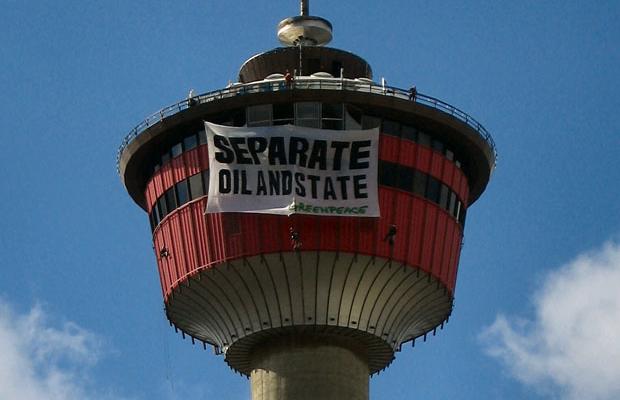
From the Edmonton Journal comes news that some Greenpeace members rappelled off the top of Calgary Tower to hang a banner that read “Separate Oil and State.”
Scott Blasken got this shot from his office window Tuesday morning after Greenpeace unfurled a banner from the Calgary Tower.
Hey, I’m all in favor of separating oil and state. But that means no strategic oil reserves; no taxes, including carbon taxes; no cap-and-trade; no regulations; no moratoriums or bans on offshore or other drilling; no special protections of any kind, including caps on liability for actual damages to private property caused by oil companies;1 no eminent domain (ab)use; and no mercantilistic and imperialistic wars to make the world safe for domestic consumption of foreign oil. But somehow I don’t expect all of this is what the Greenpeace activists confusedly mean by “separate oil and state.” Alas and alack.
I’m not talking about limited liability for shareholders here. I’m referring to caps like the $75 million liability cap that has received so much attention in the wake of the BP oil spill, enacted in 1990 as part of the Oil Pollution Act following the Exxon Valdez spill. ↩
By
Dick Clark
/ June 19, 2010 / 1 minute of reading
Share
With the central government now directly controlling some 20-30% of staple food production, Venezuelan president Hugo Chavez is certainly striving to put other people’s money where his mouth is. According to CNBC:
Mountains of rotting food found at a government warehouse, soaring prices and soldiers raiding wholesalers accused of hoarding: Food supply is the latest battle in President Hugo Chavez’s socialist revolution.
Venezuelan army soldiers swept through the working class, pro-Chavez neighborhood of Catia in Caracas last week, seizing 120 tons of rice along with coffee and powdered milk that officials said was to be sold above regulated prices.
“The battle for food is a matter of national security,” said a red-shirted official from the Food Ministry, resting his arm on a pallet laden with bags of coffee.
Centrally planned economies fail because they can’t calculate. Venezuela is just another tragic example. No matter how many grocers Hugo Chavez terrorizes, he won’t be able to fix the flaws inherent in any command economy.
Apropos Jacob Huebert’s excellent post a few days ago on the time Before We Worshipped Presidents, our lesser rulers are getting increasingly used to their special, above-the-law status as well. Watch how Democratic Congressman Bob Etheridge responds to being peacefully asked a simple question by a well-dressed student on a public street:
Congressman Etheridge thinks he can interrogate and assault someone simply for having the temerity to ask him a question in public, apparently without fear of retaliation or legal consequences, despite being recorded. He has a right to know who the student is? I don’t think so. He’s not police. I don’t think even a police officer would have cause under positive law to demand identification and assault the student simply for video recording and asking a question in public. In any case, their authority is illegitimate and what we have here clearly is assault even under current positive law.
What’s more disturbing is that this incident is indicative of just how much our petty tyrants view themselves as being above us and the law — though I suppose assaulting one person on the street is an improvement over assaulting millions through his legislative acts; if only he and his fellow control-freaks would cease the latter, the world would be a much better place and their private crime manageable.
I was privileged to attend to the Fifth Annual Meeting of the Property and Freedom Society last week. It was held in beautiful Bodrum, Turkey at the Hotel Karia Princess, from June 3-7, 2010. The list of speakers may be found in the Program. This is my second, having also attended the inaugural meeting in 2006. I’ll put up another blog soon with more details about the event, but for now let me say it was without a doubt the best liberty related event I’ve ever attended. And two of my fellow TLS co-bloggers also attended–Gil Guillory and Juan Fernando Carpio.
Group photo from the Fifth Annual Meeting, June 2010, Hotel Karia Princess, Bodrum
Professor Hoppe’s opening address, “The Property And Freedom Society — Reflections After Five Years,” is published here on The Libertarian Standard today. It’s a fascinating, informative, and perceptive overview of various libertarian paleo- and related alliances over the years.
Hoppe surveys the mistakes of former alliances, and lessons learned; and also devastatingly illustrates how the state has coopted even most free market think tanks into serving the state’s aims:
The strategy of Hayek and of the Mont Pelerin Society, then, had to fail. Instead of helping to reform—liberalize—the (Western) State, as they intended (or pretended?) to do, the Mont Pelerin Society and the international “limited-government” think-tank industry would become an integral part of a continuously expanding welfare-warfare state system.
Indicators for this verdict abound: The typical location of the think tanks is in or near the capital city, most prominently Washington, DC., because their principal addressee is the central government. They react to measures and announcements of government, and they suggest and make proposals to government. Most contacts of think-tankers outside their own institution are with politicians, government bureaucrats, lobbyists, and assorted staffers and assistants. Along with connected journalists, these are also the regular attendees of their conferences, briefings, receptions and cocktail parties. There is a steady exchange of personnel between think tanks and governments. And the leaders of the limited government industry are frequently themselves prominent members of the power elite and the ruling class.
Most indicative of all: For decades, the limited government movement has been a growth industry. Its annual expenditures currently run in the hundreds of millions of dollars, and billions of dollars likely have been spent in total. All the while, government expenditures never and nowhere fell, not even once, but instead always and uninterruptedly increased to ever more dizzying heights.
And yet, this glaring failure of the industry to deliver the promised good of limited government is not punished but, perversely, rewarded with still more ample funds. The more the think tanks fail, the more money they get.
The State and the free market think tank industry thus live in perfect harmony with each other. They grow together, in tandem.
I’ve noted in recent posts that while some left-libertarians seem to oppose standard libertarians’ positive endorsement of “capitalism” for semantic or strategic reasons, for others they actually oppose the substance of what libertarians mean by (non-crony, non-corporatist) capitalism (see, e.g., Capitalism, Socialism, and Libertarianism, and links in that post; see also Wirkman Virkkala’s post A capital ism?). An example of those with a more semantic or strategic concern would be Sheldon Richman, who is concerned about the “baggage” associated with the word, which will hamper our getting our pro-property rights, libertarian message out. Thus he favors using “free market” instead, but as far as I can tell this is similar to what we mean by “capitalism”–a libertarian society with a market based on respect for property rights, which of course includes private ownership of the means of production (and everything else). (See also Sheldon’s comment to Should Libertarians Oppose “Capitalism”?) Another would be Jock Coats, who notes here that while the baggage of the term “capitalism” might have turned him off had he not also seen the term “free-market anti-capitalism,” now that he understands the term he is “quite happy to be identified as an Individualist Anarchist/Mutualist and at times an Anarcho-Caplitalist,” and is “for keeping ‘capitalism’ as a word in our lexicon.”
To be clear, I think the semantical and strategic debate is one we can have, but it’s different than a substantive disagreement–and we can have that discussion too. But these are separate discussions and should not be intermingled. This leads to confusion at best and equivocation and dishonesty (on the part of leftists) at worst.
In my view there is little doubt that libertarians who have concerns about the appropriate words to use or strategic matters are of course libertarians. We just differ on the best way to convey and spread and communicate about our ideas. But those who disagree on substance may simply not be libertarians. This should not be masked by conflating the discussion with more mundane issues of semantics and strategy.
Now some of the left-libertarians more concerned about terminology and strategy deny or downplay the charge that at least some of them have much more than a mere lexical disagreement with us. So it is good that some of them are willing to explicitly admit this. Take, for instance, one Roman Pearah, who writes in Hmmm…No, Sir. I Don’t Like It.: …