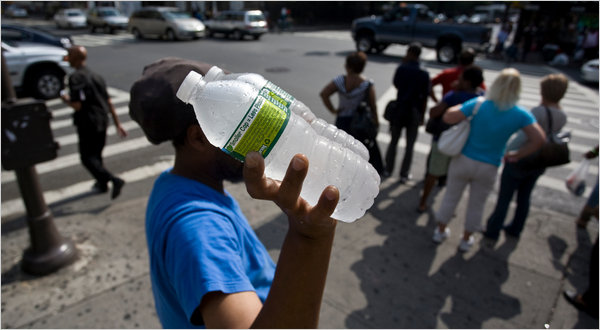
The caption accompanying this NY Times article picture of a street vendor selling bottled-water reads “Many sidewalk peddlers are doing record business, though the city considers it against the law to sell water without a license.”
I think Brad Spangler’s timely Facebook status update expresses how one should react to this:
Note carefully that states will be glad to bust down doors, “sweep streets” and so on in order to combat the problem of child prostitution. What states will not do is stop making the only choice for many prostitution or starvation, by impoverishing the populace with taxes, regulation and the sclerotic choking off of economic opportunities other than prostitution.
“People who love only once in their lives are. . . shallow people. What they call their loyalty, and their fidelity, I call either the lethargy of custom or their lack of imagination.”~ Oscar Wilde
I have an admission to make: I didn’t watch any of ESPN’s coverage of “The LeBron Decision.” I don’t remember what I was doing, but it probably involved something on the order of importance of putting clean newspaper in a bird cage or trying to identify navel lint or trimming my pet’s toenails. You know—big, important, relevant stuff.
That disclaimer aside, I find myself puzzled by the coverage LeBron’s decision has gotten after he made it. Luminaries from across the entertainment and sports spectrum, including the august Bryant Gumble, have jumped on the LeBron-is-a-schmuck bandwagon. (If you’re hoping to get a seat, I say move fast. Bob Ryan might save you one, if you ask nicely.) Charles Barkley has chimed in, as has Michael Jordan (MJ). Apparently LeBron embarrassed himself as he pandered to the excessive coverage. (Actually, maybe he did.) Gumble, speaking as part of the closing commentary of his HBO sports news magazine, accused LeBron, among other things, of being shallow and overly pre-occupied with winning. MJ, ostensibly commenting on the fact that LeBron has “teamed up” with Dwayne Wade and Chris Bosh versus staying in Cleveland, supposedly said, “I would never have called Magic [Johnson] or Larry [Bird].” Really?
Real simple — get the hell out of their way and let them operate! Is it too much to ask of the MTA to allow private bus or shuttle van services to serve the routes in which 570 former bus stops are now out of service because of budget cuts?
Building owner Ricky Wong is being shafted by NYC’s Landmarks Preservation Commission, but it’s his fault because he should have known better than to think that “the land of the free” was anything other than an empty slogan when it comes to property ownership.
Five months after the Department of Buildings approved his proposal for renovation, Wong received a letter on June 7 from the [LPC] commission telling him that they wanted to designate his three-story building — a specimen of the early 19th-century Federal style — as a city landmark. That designation would likely prevent Wong from adding four stories, a project he’d been planning since he bought the building in 2003.
The targeted site for LPC destruction
In contrast to the vanilla eminent domain takings, Landmarks is the fullest expression of centralist planners to control and shape the living environment of society to their whim but at your expense. In the standard eminent domain scenario, the owner can at least expect some monetary compensation for the theft forced transfer of his property. On the other hand, when a building is subject to a Landmarks designation, the legal owner ?remains, but in reality he is reduced to the role of an unpaid property custodian for the city government.
He may no longer do whatever he feels is the best and highest use of his property. Any minor renovation or visible alterations to the exterior will have to wait for a committee hearing with all the requisite filing fees, architectural drawings and paperwork filings in the meanwhile. Potential business lessees that may have an interest in the retail space will have to file proposals with Landmarks which include architectural renderings of the intended build-out in order to obtain approvals that certify that their usage and signage is in conformity with Landmarks’ tailored material and color lists, often with attached samples of awning fabrics or paint colors. None of this comes cheap of course. Many potential businesses balk at the steep barrier of entry and seek less prohibitive locations.
Like any city with zoning restrictions, the sales price of a building is determined not only by the existing structure, but what can be built given the zoning envelope. It is reprehensible enough that zoning regulations are the norm, but it’s a lot worse when someone purchased something with the reasonable expectation that they would be able to profit by maximizing the structure within the proscribed limits and find themselves in a situation quite beyond their control in which not only will they not profit, but stand to lose based on how much they will have overpaid for that property.
In the months since January, Mr. Wong hired an architect and gutted the structure, knocking down all interior partitions. But then, on June 7, the LPC sent a letter.
“I spent all the money already,” Mr. Wong said. “And now they turn it into a landmark. I have no idea how they want me to do it. Of course, I don’t want it to be a landmark building. Then all my money is gone.”
Mr. Wong bought the building with the expectation of adding on additional stories. He was willing to pay the price based on this assumption, a quite normal one. But when some overly-nosy neighbors got wind of his plans, they contacted the commission in the hope of stopping the project, one they did not desire in their neighborhood among a number of others.
If the building is ultimately designated a landmark, Mr. Wong will have lost much his invested money and time, something which should trouble anyone who stands for private property rights.
In the chart below, provided by chartoftheday.com, one can see how grim the job situation has become. The long term-trend experienced since 1961 has been abandoned for what can only be described as stagnation in job creation. As jobs remain flat, of course, the size of the job force will continue to grow as more young people graduate from college and secondary school. This is partly why unemployment among teens and twentysomethings is now about 25 percent.
According to chartoftheday.com:
Today, the Labor Department reported that nonfarm payrolls increased by 431,000 in May. It is worth noting that a large majority of last month’s gain in payrolls was due to the hiring of temporary workers for the 2010 census. Today’s chart provides some perspective on the US job market. Note how the number of jobs steadily increased from 1961 to 2001 (top chart). During the last economic recovery, however, job growth was unable to get back up to its long-term trend (first time since 1961). More recently, nonfarm payrolls have pulled away from its 40-year trend (1961-2001) by a record percentage (bottom chart). In fact, the number of US jobs is currently at level first reached in early 2000.
So far, the current “recovery” has produced a net loss of 133,000 jobs. During the same point in the last recovery (2003), the economy was adding 200,000 to 300,000 jobs per month. Calling the current situation a recovery is risible to anyone who is out looking for a job right now, especially since workers are now experiencing the longest periods of joblessness experienced in decades.
We can add to this the fact that the debt crisis in Europe has now spread to Hungary. So now, Greece, Portugal, Ireland, Italy, Spain and Hungary are all now facing serious debt crises and even risk of default. The European economy is in disarray, and investors were not pleased as the Dow plunged more than 300 points to below 10,000.
The homebuyer tax credits are gone, the stimulus is beginning to wear off, and there is nothing left that the feds can do to stave off another crisis since interest rates are already effectively zero and the federal government is more more broke than ever. State and local governments are in even worse shape.
Needless to say, this does not bode well for the “recovery.”