
Taxation Destroys Prosperity

(Austrian) Economics, Anti-Statism, Taxation
Share

In this article, I want to emphasize how much wealth is destroyed due to taxes, and how much better off we would be if we didn’t have them at all. This is the lost prosperity that we have missed.

Let’s crunch some numbers. The average U.S. economic growth in GDP from 1913 to 2005 has been roughly 3% year to year. The next figure displays this in terms of Year 2000 Dollars (this allows us to take inflation into account). Recall that 1913 is the year the Sixteenth Amendment was ratified, which instituted the income tax.
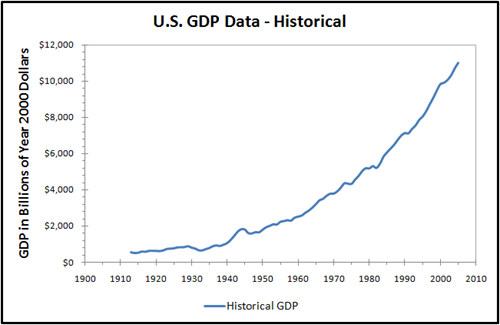
Upon inspection, one might say that this actually looks pretty good, 3% per year isn’t too shabby. However, substantial data that indicates that countries whose governments spend a greater percentage of wealth annually also experience diminished growth. I have scanned two graphs from Mary Ruwart’s Healing Our World (chapter 12) to help illustrate this. (Both are originally from Gwartney, Holcombe, and Lawson’s article entitled “The Scope of Government and the Wealth of Nations.”)

Note the trend in this first graph: the less a government spends its people’s wealth, the greater growth that nation will experience. This is correlated from hundreds of data points from various countries over time.
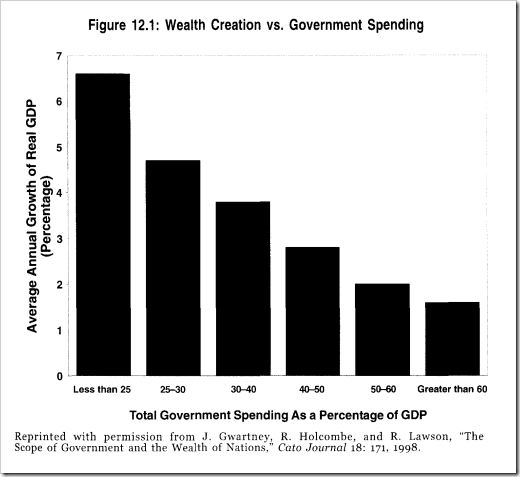
What is striking about this data is that as government spends ever less money, the rate of growth expands exponentially rather than linearly. In other words, a 10% reduction in government spending makes an even greater difference when moving from 25 to 15% total government spending (nearly 2% increase) than moving from 60% to 50% (about 0.25% increase).

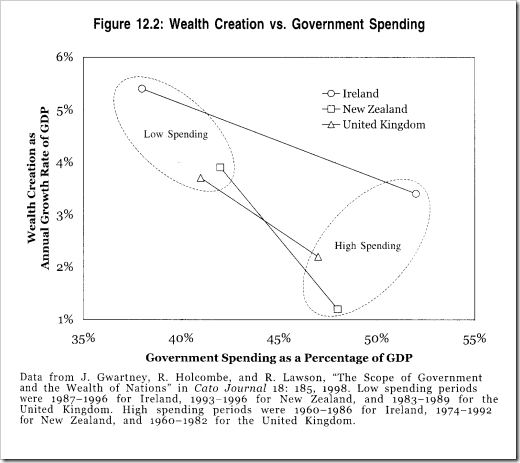
So, does this relationship hold in specific cases? In fact, it does. This next graph shows how Ireland, New Zealand, and the United Kingdom realized greater growth when they reduced government spending (data spans the years 1960 to 1996, see the caption).
wealth_creation

Each of these countries had governments that spent greater than 45% of their annual GDP. Thus, each country experienced low economic growth, between 1 and 4%. These are the only three developed countries that made significant reductions in government spending between 1960 and 1996. One can clearly see that when each country reduced spending, their economic growth shot up significantly. In the case of New Zealand, their growth rate expanded three times over! Less aggression expands wealth.

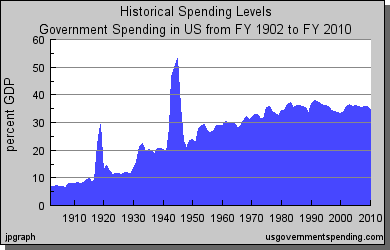
Think back to what you have learned in personal finance. Remember the concept of compound interest, that savings early on contributes to wealth expansion later? What is lost due to taxation is compounded over time. And when we consider what the United States government spends, the obvious conclusion is that we have missed an extraordinary opportunity. Over the last 100 years, the United States Federal Government has dramatically increased its consumption of annual GDP. You can readily see this in the next graph. Around 1915, the Feds spent only around 10%, and aside from the two gargantuan spikes (the World Wars), the general trend has been a steady increase to 35-40% of annual GDP. No wonder the economy is only growing at 3% in supposedly the most free nation on earth!
historical_spending

Now we are in the position to calculate the prosperity we have lost due to the income tax. It is actually a very simple calculation to make, if you make some simplifying assumptions.

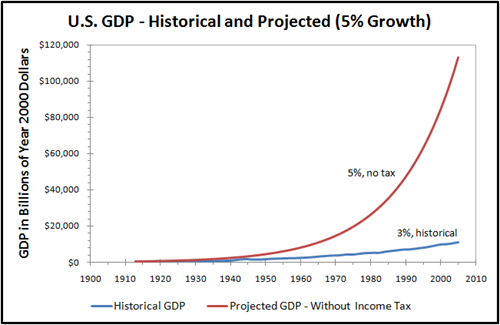
In this case, I will assume no variation year to year in growth, and that the growth rate is 5% – only 2% above the current average rate. This is actually a conservative estimate when you think about it, because we would likely see upwards of 4-5% increase in annual growth if the income tax were eliminated as per the previously cited data. But for now, let’s call 5% the lower bound. Here’s what you get:
image

The difference between 3% and 5% growth is nothing short of startling. The conservative estimate is that we would likely be 8 to 10 times better off without the income tax, and that number would go up even further if the growth rate is greater. Can you imagine what could be done with this kind of prosperity? We are often amazed at what we can do and produce with modern science and technology and with the connectivity of the internet. But the difference we can anticipate with this much growth would likely dwarf what we see now. Most likely, by eliminating the aggression of taxation we would increase wealth creation somewhere between 3 and 18 times!

We have to realize that trade, the social mechanism of increasing our economic well-being, is a win-win proposition. By definition, when you and I agree to trade the fruits of our labor, we are implicitly agreeing that we are both better off by making the transaction. Conversely, government force is a lose-lose proposition. No one but the thief is made better off when coercion is exacted, and laws of nature do not change when the collector wears an IRS uniform and the spender is a government bureaucrat.

Those who argue that it is only through government that we will cure disease, help people out of poverty, and make this world a better place have not seen the data. Prosperity is what cleans up cities, gets people into jobs, and heals illness, and the government will always fail when it tries to intervene. Why? Because government only works by aggressing against its subjects, which unequivocally makes the subjects worse off.

How amazing that the world works in this way! We do not have to choose whether we will have either aggression and prosperity, or peace and poverty. Rather, peace and prosperity go hand in hand. Thank God, we live in a win-win world.

For now, however, we have little choice in the matter of taxes. We do the best we can to avoid as many taxes as possible and live in peace, because otherwise the strong arm of the State is waiting. Let us keep pushing back the State through persuading our fellow man of the evils of the State, trading peacefully, and working for positive change in our communities.

And the fight goes on…

To read more about the evils of taxation, check out my article series on LibertarianChristians.com, where this was originally posted.

Taxation Destroys Prosperity Read Post »

America’s ‘Lost Decade’ continues

Business Cycles, Statism
Share

I was looking at the new earnings data released by the BLS this morning, which shows real average income for all workers declining 0.6 percent year over year. Realistically speaking, this means that earnings are flat for people with jobs. People without jobs, who aren’t included in the survey, are likely much worse off in general.

We might also keep in mind that when making year over year comparisons, that March 2009 was just a few months after the panic of 2008, so to have had so little improvement compared to the early months of 2009 is a grim commentary indeed.

Also, when thinking about household debt, unemployment, and continued increases in the price of gasoline (which rose 15 percent over the last 6 months), household budgets in America are in extremely dire straits.

If this were only a short term phenomenon, it would be one matter, but when looking at what has happened over the past decade, the continued malaise is really just more of the same in spite of the fact that it was masked by a brief bubble in the middle of the decade.

For example, American median household income in 1998 (adjusted for inflation) was $51,295. Ten years later, in 2008, it was $50,303. Over the same period, household debt increased 139 percent.

Now come the years of de-leveraging with stagnant incomes, which will be painful.

America’s ‘Lost Decade’ continues Read Post »

I Do Not Support Peter Schiff For Senate

(Austrian) Economics, Democracy, Vulgar Politics
Share

Peter Schiff is an excellent economist and his appearances on various financial shows (and the corresponding Youtube clips and blog posts) have contributed to the economics education and financial health of thousands of people. Why on earth is he running for the Senate?  1 Does he really believe that the political process has even a remote chance of limiting the size and scope of government? Such a belief is truly absurd for two reasons:

  1. The inherent inertia of the political workings of Washington D.C. makes it nearly impossible to slow down the growth of government; actually shrinking the government from the inside borders on impossible.
  2. Even if I am wrong that it’s an impossibility to shrink government from the inside, what it would require is more than three libertarians. Were Schiff to win, and Ron Paul’s son Rand Paul to win also, that would make 3 libertarians in Congress (I’m generously calling Rand a libertarian, mind you) vs 532 socialists of varying degrees; worse, their forces would be split, as Schiff and Rand would be in the Senate (2 vs 98) and Ron would be in the House (1 vs 434). You’ve got to be kidding me.

I’d prefer to see Schiff save his money and that of all the people who would donate to his campaign (freedom-lovers) so they can use it to brace for the impact of this onsetting depression. Tossing so much into the political advertising money pit is a total waste. That’s an enormous amount to spend ($30 Million or so?) in the hopes that Peter can get elected and make great speeches on CSPAN, given that he already gets invited to speak on the financial circuit with little or no out-of-pocket expense on his part. In fact, Schiff has already had to cease appearing twice per week on one of the financial shows due to campaign laws, so now we’re back to all Keynes all the time. And even if he were to win, it’s doubtful the Republican leadership would seat Schiff on any of the important financial committees, so what would he really accomplish in the Senate? Maybe introduce a few bills which never make it out of committee?

Worst of all, I fear Schiff doesn’t really have a shot of winning since libertarianism doesn’t really resonate with the masses (yet), so all of that time and money campaigning will likely be wasted. (Yes, I know I just made an objective truth claim about others’ subjective evaluations which is an Austrian no-no.)


  1. Schiff’s campaign website has been taken down. ↩

I Do Not Support Peter Schiff For Senate Read Post »

Boettke Receives 2010 Adam Smith Award

(Austrian) Economics
Share

APEE LogoCongratulations to Professor Peter Boettke on receiving the 2010 Adam Smith Award from the Association of Private Enterprise Education (APEE). Teaching economic literacy and the principles of liberty is absolutely essential to making progress in the fight against the state. Professor Boettke is to be commended for his tireless efforts in this regard.

Boettke Receives 2010 Adam Smith Award Read Post »

Capitalism is the Greatest Achievement of Human History — Praise It

(Austrian) Economics
Share

I am grateful that we have capitalism to the extent that we in fact do have it — and although we certainly don’t have enough capitalism, I am grateful for how much we actually do have. Everything we have in the modern civilized world is only possible due to capitalism and the accumulation of capital. It is the natural expression of free markets whenever there is a sufficient level of civilization. The accumulation of capital is essential for the progress of civilization in all aspects. Technological progress alone is insufficient. While capital accumulation has occurred to various extents throughout history, the system of capitalism is a more recent development allowing for much more efficient capital accumulation and development.

It is actually quite incredible to think of how much prior civilization, technological progress, and accumulated capital are necessary to make something as simple as a screw. Even with the instructions and all relevant knowledge, primitive people wouldn’t be able to make them for at least decades, possibly centuries. When you think about the precise dimensions of something as simple as a screw, you realize it obviously required something very precise to make it (e.g., precise casting). And that thing required something precise to make it, and so-on and so-forth. It is a process of building up more and more sophisticated tools from simpler ones, which requires significant capital accumulation.

It is also doubtful that many people, if any, know the entire production process — from raw earth materials to finished product — for even something as simple as a screw. Its production requires the voluntarily cooperative interactions of numerous people. Furthermore, as my friend Juan Fernando Carpio has argued in a forthcoming paper, the human mind and body are both capital goods, which require development. The entirety of human knowledge, considered in the abstract, is akin to the accumulation of capital goods. To the extent that we have civilization, such is only possible because of the accumulation of different kinds of capital.

This is something ignored by socialists of every variety, be they anarchist or Statist socialists. (I would argue that an anarchist socialist will, when faced with the reality of how free people actually act, either have to at least tacitly endorse private property and capitalism, or will become a Statist). The various systems advocated by socialist anarchists all hinder or make impossible capital accumulation. For example, various flavors of anarchist socialism might attempt to ban — how can they do this while remaining anarchist? — absentee ownership or the separation of ownership and control (i.e., corporations). The banning of either would result in rising time-preferences and thus greatly decrease incentives for saving and capital accumulation.

Some Suggested Readings

Ludwig von Mises, 2008 [1956]. The Anti-Capitalistic Mentality. Ludwig von Mises Institute, Auburn, AL.
Reisman, George. 2002. “Some Fundamental Insights Into the Benevolent Nature of Capitalism“. Mises Daily. October 24.
Rothbard, Murray N. 2009. “Capitalism versus Statism“. Mises Daily. September 29.
Leonard E. Read, “I, Pencil,” The Freeman, December 1958.

Capitalism is the Greatest Achievement of Human History — Praise It Read Post »

Scroll to Top