Education

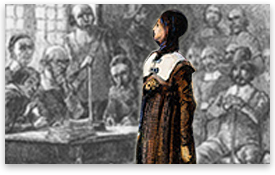
AnneHutchinson2Last month, I mentioned America’s first individualist anarchist, Anne Hutchinson. She’s a hero of mine, for obvious reasons, despite my not sharing her religious beliefs.

One of the several reasons I’m enjoying Sarah Vowell’s The Wordy Shipmates is that I’m learning more about Hutchinson. For example, I love this detail:

The daughter of a persecuted Puritan minister who helped her cobble together the best education possible for female children (who were denied university attendance), Anne Hutchinson is one of the brainiest English-women of the seventeenth century. Yet she is no stranger to the goopy fluids of female biology. Besides birthing her own litter [of 15 children, by the way!], she works as a midwife, delivering babies and no doubt serving the brew imbibed before and after labor, the wonderfully named “groaning beer.”

Here’s my favorite detail within the detail:

By aiding Boston’s new mothers, Hutchinson quickly befriends a lot of women. She starts leading the women in a regular Bible study in her large, fine home.

These Bible-study group became the seedbed of antinomianism: a new religious individualism (and heresy) within New England Puritanism. It also became the basis of political and philosophical individualism more generally, thus Murray Rothbard’s description of Hutchinson in Conceived in Liberty as America’s first individualist anarchist.

She preached the necessity for an inner light to come to any individual chosen as one of God’s elect. Such talk marked her as far more of a religious individualist than the Massachusetts leaders. Salvation came only through a covenant of grace emerging from the inner light, and was not at all revealed in a covenant of works, the essence of which is good works on earth. This meant that the fanatically ascetic sanctification imposed by the Puritans was no evidence whatever that one was of the elect. Furthermore, Anne Hutchinson made it plain that she regarded many Puritan leaders as not of the elect.

The Massachusetts powers that be understood that Hutchinson’s Bible-study sessions were central to the dissemination of her religious and political heresies and so, as Sarah Vowell relates,

In September of 1637 … [t]hey resolve, writes Winthrop, “That though women might meet (some few together) to pray and edify one another,” assemblies of “sixty or more” as were then taking place in Boston at the home of “one woman” who had had the gall to go about “resolving questions of doctrine and expounding scripture” are not allowed.

"The Bill of Rights," Vowell comments, "with its allowance for freedom of assembly, is a long way off."

[Keep reading…]

{ 0 comments }

I recently came across the website and podcast ”Complete Liberty,” by Wes Bertrand, also featuring Bertrand’s 2007 book Complete Liberty: The Demise of the State and the Rise of Voluntary America (print; PDF). The podcast has some excellent episodes, including a whole series on IP—episodes 89–99.

{ 0 comments }

jefftucker

Jeffrey A. Tucker

Jeff Tucker of Laissez Faire Books is giving a free Webinar this afternoon: “Commerce and the Commons: How Enterprise Will Survive and Thrive the Death of Intellectual Property“. This event is sponsored by European Students For Liberty, and appears to be open to anyone. Info below:

Tuesday, January 29, at 20:00-21:00 CET/2:00PM-3:00PM EDT

Where? On your Computer!

Speaker:  Jeffrey Tucker

Topic: Commerce and the Commons: How Enterprise Will Survive and Thrive the Death of Intellectual Property

Register here: https://www2.gotomeeting.com/register/882656282

Intellectual Property Rights have always been a hot topic among libertarians. One of the main arguments in favor is the belief that these rights are essential for entrepreneurship. Businesses wouldn’t be able to innovate without the financial fruits of their intellectual labor. But exactly how essential is intellectual property in this regard? Would an end of these rights mean an end of commerce? Or the reverse? Find out during this upcoming webinar!

Jeffrey Tucker is executive editor of the newly refurbished Laissez Faire Books, a leading publisher of libertarian books, and founder and head of the Laissez Faire Club. He also author of Bourbon for Breakfast (2010), It’s a Jetsons World (2011), and Beautiful Anarchy (2012).

[C4SIF]

{ 0 comments }

Kinsella On Liberty

As many of my readers know, I often lecture and speak and give podcast or radio interviews on various libertarian topics and issues, such as intellectual property (IP), anarcho-libertarians, Austrian law and economic, contract theory, rights and punishment theory, and so on. I also blog and comment regularly on such matters in various blogs (primarily The Libertarian Standard, on general libertarian matters, and C4SIF, on IP-related matters), Facebook, and so on—often posting my take on a given issue in response to a question emailed to me or posted online.

This month I am launching a new podcast, Kinsella on Liberty. I expect to post episodes once or twice a week. The podcast will include new episodes covering  answers to questions emailed to me (feel free to ask me to address any issue of libertarian theory or application) as well as interviews or discussions I conduct with other libertarians. I’ll also include in the feed any new speeches or interviews of mine that appear on other podcasts or fora, as well as older speeches, interviews, and audio versions  of my articles, which  are collected for now on my media page). Audio and slides for several of my Mises Academy courses may also be found on my media page, and will also be included in the podcast feed later this year. Feel free to iTunesSubscribe in iTunes or RSSFollow with RSS, and spread the word to your libertarian friends. I welcome questions for possible coverage in the podcast, as well as any criticism, suggestions for improvement, or other feedback. My general approach to libertarian matters is Austrian, anarchist, and propertarian, influenced heavily by the thought of Ludwig von Mises, Murray N. Rothbard, and Hans-Hermann Hoppe. My writing can be found in articles here and blog posts at The Libertarian Standard and C4SIF, such as:

On IP in particular, which I’ll also cover from time to time in the podcast, see:

[C4SIF; SK; PFS]

{ 3 comments }

Well, technically, Anarchy 100, a seminar at Lebanon Valley College. I was alerted by a friend to this interesting course by Michael Kitchens, an Assistant Professor of Psychology. The reading materials include many articles and books from Austro-anarchists such as Roderick Long, Bob Murphy, Hans-Hermann Hoppe, Walter Block, Anthony Gregory, Tom DiLorenzo, Lew Rockwell, Rothbard, and myself. This is cool. The reading list would make a good book. From the course page:

SELECT RESOURCES/INFORMATION

Books

Introductory Essays on Anarchy

The State & Anarchy 

Market Anarchy

Justice Anarchy

Defense  & Security

Roads & Highways

Civilization, Culture, & Life

{ 1 comment }