
Our Efficient, All-Volunteer Killers

Imperialism, War
Share

Steve Chapman extols the benefits of having an all-volunteer military force:

A few decades ago, the draft was a requirement for any major military undertaking. No one would have dreamed of fighting the Germans and Japanese, or the North Koreans and Chinese, without calling up young men for mandatory service. Not until the waning years of the Vietnam War did the nation elect to rely entirely on volunteers.

It was a controversial step, and one whose durability was very much in doubt. But in the intervening decades, the draft has gone from being indispensable to being unthinkable. Even the extraordinary demands of two difficult wars have not induced a reconsideration.
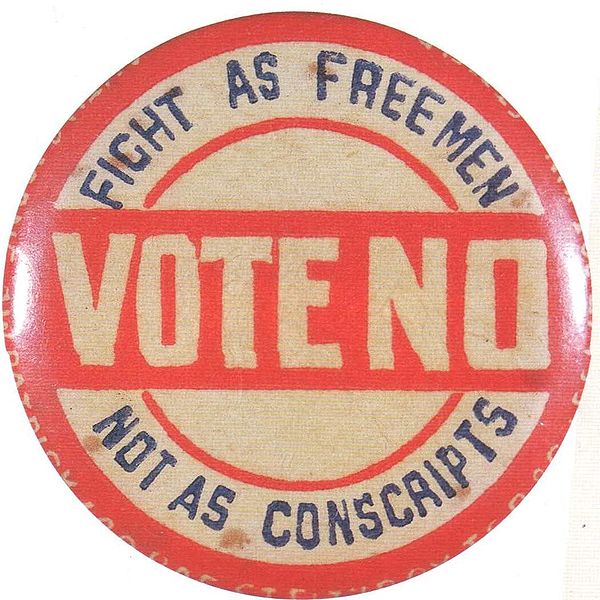
Anti-conscription badge from WWIEven the military’s leadership recognizes now that armies perform better when they’re filled with people who actually want to be there, and as Chapman points out, it’s a more efficient use of training dollars to spend them on Army careerists than on guys who’d rather be smoking pot and watching football.

If this is the extent of Chapman’s argument then I agree, but I’m not any more comforted by the fact that the military’s bombing and killing of poor people overseas are performed by people who actually want to do that sort of thing.  And he ignores the fact that young men must still notify the government of their whereabouts via Selective Service in case the draft is reinstated.  If the military really does not want conscripted men (and possibly women) among its ranks, why does the infrastructure for conscription still exist?

More dubious is Chapman’s concluding paragraph:

It was once a novel experiment: fielding a force to protect freedom without grossly violating freedom by dragooning young men to serve. But it’s worked so well we’ve almost forgotten there’s an alternative.

“Protect freedom” is a canard I expect from National Review, not a supposedly libertarian publication such as Reason.  Few if any all-volunteer forces have ever been used to protect Americans’ freedoms, even during the Revolutionary War (see volume 4 of Murray Rothbard’s Conceived in Liberty); and there isn’t a single military campaign undertaken in the past century that could be called a legitimate defense of freedom.  If one wishes to sing the praises of America’s efficient, all-volunteer killers, at least one shouldn’t pretend they exist for any reason other than to satisfy the imperialist aims of the Washington elite.

Our Efficient, All-Volunteer Killers Read Post »

Grading the Pledge to America

Corporatism, Democracy, Health Care, Imperialism, The Right, Vulgar Politics, War
Share

So….the Republicans have put out their Pledge to America. Is it any good?

Jeffrey Tucker sums it up pithily by juxtaposing short quotes from it and the Declaration of Independence:

Declaration of Independence (1776): “That whenever any Form of Government becomes destructive of these ends, it is the Right of the People to alter or to abolish it…”

A Pledge to America (GOP, 2010): “Whenever the agenda of government becomes destructive of these ends, it is the right of the people to institute a new governing agenda and set a different course.”

If this goes on, related fellow TLS blogger Daniel Coleman to me, in another 100 years it will be “Whenever a subpoint of policy within a government agenda becomes destructive to these ends, it is the right of the people to organize a committee to change those subpoints of policy and replace them with better subpoints.”

Liberty Central, the Establishment’s attempt to co-opt the Tea Party, has a poll asking us to grade the Pledge. Head on over there and tell them what you think of it. Fellow TLS blogger Jacob Huebert has a couple of good posts on LewRockwell.com about Liberty Central, the Tea Party, the Pledge, and Glenn Beck.

The Liberty Central poll only lets you grade the Pledge as a whole. Here is a quick graded breakdown of important aspects of the Pledge, with short reactions by me in parentheses:

Grading the Pledge to America Read Post »

Hamilton vs. Kant on War and Peace

Democracy, Imperialism, Mercantilism, War
Share

As an Aristotelian libertarian, I’m not a big fan of Immanuel Kant, his philosophy in general, or his take on world peace.  But to say that I’m not a fan of Alexander Hamilton — that statist, bank centralizer, mercantilist, and crypto-monarchist — would be a vast understatement. (For more on what’s wrong with Hamilton, see Thomas DiLorenzo’s “What Hamilton Has Wrought” and Hamilton’s Curse.)

I discussed the democratic peace thesis and problems I see with the Kantian Triangle — resting on republican government, international trade, and international law and organizations — in my previous post, Triangulating Peace? Or, Three Foundations for Oppression? While trade is a peaceful activity and economic interdependence can promote peace among states, it can be perverted and used for corporatist and mercantilist ends by states and international governmental organizations (IGOs), which is why, though it pains me to say it, I must side with Hamilton’s take on the matter, excerpted from Federalist #6 below:

Hamilton vs. Kant on War and Peace Read Post »

Triangulating Peace? Or, Three Foundations for Oppression?

Corporatism, Democracy, Non-Fiction Reviews, War
Share

[The following is a revised version of a reaction paper I wrote for a graduate seminar in international conflict back in 2005.]

In Triangulating Peace: Democracy, Interdependence, and International Organizations, Bruce Russet and John Oneal mount the most thorough defense of the democratic peace thesis I have yet seen. Indeed, they go beyond the democratic peace thesis to posit a Kantian peace consisting of the interrelated and reciprocal effects of democracy, economic interdependence, and international law and organizations. I am not without criticism, however.

I have always been skeptical of the democratic peace thesis, which posits that democratic states do not go to war with one another, in part because it seemed to me to be incomplete. Russet and Oneal attempt to shore up that incompleteness by emphasizing the pacifying effects of both bilateral and global economic interdependence as well as (though not unproblematically) international law and organizations.

Despite the impossibility of discovering empirical laws via inductive and statistical methods, it may be true that (liberal) democracies rarely go to war with one another and, ceteris paribus, might be less war prone than other states. But I am not confident this trend will hold for all times and places.1 Moreover, democracies may still be more likely to go to war with non-democracies for ideological reasons. “We’ve” got to make the world safe for democracy, after all.


  1. Joanne Gowa, in Ballots and Bullets, argued that the democratic peace was an artifact of the Cold War; it appeared to be true only because Western, capitalist, democratic nations had a shared security interest against the Soviet Union. My professor for the above-mentioned seminar, David Sobek, argued that Gowa’s book suffers from methodological deficiencies, but said that he had been working on an article (I don’t know if it was ever published) that improved on Gowa’s methods and he was surprised to find her results confirmed. 

Triangulating Peace? Or, Three Foundations for Oppression? Read Post »

Aphoristic Observation: (Statist) politics is the continuation of war by other means.

Democracy, Pop Culture, Vulgar Politics, War
Share

A while back, I was watching the movie Crimson Tide and made the following observation.

There was mention of the famous dictum by the Prussian general, military historian, and theorist Carl von Clausewitz: “War is the continuation of politics by other means.”

There is a profound truth in that dictum. It identifies shared characteristics of statist politics and war: anti-social conflict, some imposing their will on others, destruction and redistribution of wealth, and so on. When statist political means fail to have the desired result and recourse is made to naked war, the true character of both the aggressors and the statist political process is revealed.

But I think that von Clausewitz got it backwards; the observation would have been more profound and true had he written instead: “(Statist) politics is the continuation of war by other means.”

Ballots replace bullets within the democratic state but conflict persists with special interest groups vying for the reins of power so that they can use the perceived legitimacy of the state to impose their will on each other. Beneath the sophisms that grant the state legitimacy there lies the same threat or use of initiatory violence that is present in war. Open war is traded for the illusion of peace.

Might this quip from Ronald Reagan touch upon a similar insight? “Politics is supposed to be the second-oldest profession. I have come to realize that it bears a very close resemblance to the first.” Is he referring to war? Or prostitution? Both analogies would be apt. War is often a boon to both prostitutes and politicians, though prostitutes at least are usually more honest about what they do and can conduct their business peacefully.

Aphoristic Observation: (Statist) politics is the continuation of war by other means. Read Post »

Scroll to Top