Future of Freedom Fund

Anti-Statism, Education, Private Security & Law
Share

Besides traditional activism such as politics and writing and speaking, on occasion intellectual entrepreneurs try to find more innovative and creative ways to work for a free society. Examples  include various forms of “new libertarian nation” projects (like Patri Friedman’s Seasteading Institute, and the Free State Project), as well as the idea of subscription-based patrol and restitution advanced by Guillory and Tinsley, or Stephen Fairfax’s ingenious proposal presented at Austrian Scholars Conference 2010, “Returning Gold to the Consumer Marketplace” (discussed here).

Along these lines, I’ve been fascinated with an idea I got when I read about an utterly fascinating legal squabble way back in 1996 or so when I lived in Philadelphia. This concerns the infamous Holdeen Trusts, and a series of cases and legal disputes centered around same. An article about it in the Philadelphia Inquirer caught my notice because it concerned the efforts of an eccentric millionaire New York lawyer, Jonathan Holdeen, to set up a series of trusts that would one day totally wipe out taxes, at least in Pennsylvania (see also The Holdeen Funds, by Rajan Mylavaganam, below).

Holdeen set up a labyrinth of trusts in Pennsylvania in the 1940s and 1950s, lasting for hundreds of years, with the accumulated trillions of dollars to be eventually used to endow and completely fund the operation of the government of Pennsylvania. He chose Pennsylvania, believing that that state’s laws were most favorable to the validity of such trusts. Holdeen “modeled his plan somewhat after that of the thrifty Benjamin Franklin who limited himself to two hundred years (1790-1990).” (Holdeen v. Ratterree, 270 F.2d 701 (2d Cir. 1959); see also Holdeen v. Ratterree, 190 F.Supp 752 (N.D. N.Y. 1960); In re Trusts of Holdeen, 486 Pa. 1, 403 A.2d 978 (1979).)

Future of Freedom Fund Read Post »

Parsing Political Language: Is Obama an Inveterate Liar?

Democracy, Taxation, Vulgar Politics
Share

With the news breaking today that “Obama suggests value-added tax may be an option,” many of my fellow libertarians are going to pat themselves on the back while (cynically) claiming that the President has broken yet another campaign promise and is, therefore, a liar. They’re wrong, of course. Politicians don’t lie. They speak precisely. Libertarians need to pay closer attention to what politicians actually say instead of misinterpreting what was said. Remember too that all language is metaphorical and definitions can vary for any word. Here’s master-linguist William Jefferson Clinton explaining it much more concisely than I:

Eat your heart out, Derrida.

Libertarians will tell you that Obama made a firm pledge not to raise taxes on any family making less than $250,000 per year. This is false. Here is the actual video:

He chose his words precisely.

Transcription: “And I can make a firm pledge: under my plan, no family making less than $250,000 a year will see any form of tax increase, not your income tax, not your payroll tax, not your capital gains taxes, not any of your taxes.”

Let’s take a look at the language there: “He can make a pledge” that no family making less than $250,000 a year will see any form of tax increase.” Note that he didn’t make a pledge; rather, he said he can make a pledge. Simple statement of fact. I believe him. It’s not difficult to make a pledge. All he has to do is say, “I pledge…” followed by the pledge. He didn’t say that. If that’s not enough to settle the issue for you, he said “no family”. Well, what’s a family? Don’t even try to define family. I could present you with 40 different definitions for family off the top of my head. It’s impossible, therefore, precisely to know whom he was referring to in this non-pledge. Not convinced yet? Well, he said “making less than $250,000 a year.” But, see, my father (a brilliant economist) taught me when I was a child that it’s imprecise to talk about “making money”. You know who makes money? The Treasury Department’s Bureau of Engraving and Printing and other counterfeiters. What productive people do is “earn money”. Understand the difference? Finally, the non-defined families which counterfeit “less than $250,000 a year” that he’s describing in his non-pledge won’t “see” any form of tax increase. They might “experience” it. They’ll certainly pay it. They just won’t “see” it.

Parsing Political Language: Is Obama an Inveterate Liar? Read Post »

Our Generous President

Taxation, The Left
Share

The President and his wife made about $5.5 million and paid $1.8 million in federal taxes in 2009. This does not include an estimated $59,639,899 in benefits that he receives annually for being president. Being the generous couple that they are, they gave $329,100 to 40 charities. That’s an average of $8,227.50 per charity. Moreover, $329,100 is also about 6% of their total income for 2009. He did donate the $1.4 million he won for the Nobel Peace prize, although it’s debatable whether he really earned that reward. Nevertheless, Obama had no problem pledging $100 million of taxpayer money to help Haiti. He also pledged $475 million of taxpayer money to rescue the Great Lakes; $3.5 billion of taxpayer money to help Africa; $1.5 billion of taxpayer money to help underwater homeowners and the unemployed; $900 million for schools; $8 billion of taxpayer money on high speed rail; and as much as 3% of GDP, which is about $415 billion of taxpayer money, on scientific research. Perhaps this is why he only donates 6% of his own income. Why be generous with your own money when you can be magnanimous with other people’s money?

Remember when President Obama told Joe the Plumber: ”I think when you spread the wealth around, it’s good for everybody”? The President was not talking about his wealth.

Our Generous President Read Post »

That vaunted liberal tolerance

Anti-Statism, Nanny Statism, Police Statism, Taxation, The Left
Share
Pro-Tax = Pro-War + Pro-Prison

First things first: Happy Tax Day to all my friends still living in the United States! And for those of you upset or angry about paying “your fair share” (which, incidentally, is only 43% of you), I’d like to remind you that thousands of Wall Street bankers, UAW “workers”, mortgage defaulters, and other welfare recipients are relying on you to pay their way. If that’s not enough to put a smile on your face, remember that you’re also financing the American Empire’s military adventures in the Middle East which make you safer and could not possible result in blowback (according to Sean Hannity and Rudy Giuliani). So, there’s that.

Speaking of taxes, here’s a left-wing career tax leech (public “school” teacher) demonstrating how tolerant liberals are of varying view points:

[Jason] Levin, the media teacher at Conestoga Middle School in Beaverton, is the leader of a group that says it wants to infiltrate and bring down the loosely organized anti-big-government Tea Party movement.

He has said he would seek to embarrass Tea Partiers by attending their rallies dressed as Adolf Hitler, carrying signs bearing racist, sexist and anti-gay epithets, and acting as offensively as possible — anything short of throwing punches.

In a now deleted post on his “Crash the Tea Party” Web site, Levin called on his supporters to collect the Social Security numbers — among other personal identifying information — about as many Tea Party supporters as possible at the numerous rallies scheduled to take place on Thursday – Tax Day.

“Some other thoughts are to ask people at the rally to sign a petition renouncing socialism. See just how much info you can get from these folks (name address, DOB, Social Security #). The more data we can mine from the Tea Partiers, the more mayhem we can cause with it!!!!” he wrote.

If you want smaller government and lower taxes, you are this avowed statist’s archnemesis — he really hates you. Shouldn’t liberals oppose the Empire’s wars in the Middle East, the bailouts and wealth transfers to Wall Street, the domestic spying programs, and the world’s largest prison system (population measured either way: in total and per capita), all of which are funded by taxes (either current or “borrowed” against future generations)? Sure, it’s possible this guy just lacks discernment, but that doesn’t justify his slimy scheme.

The silver lining here is that the Tea Party contingent can use this as evidence that their ranks are being infiltrated by pro-tax, pro-war, pro-prison leftists as the media continue to paint them as racists, bigots, and homophobes.

That vaunted liberal tolerance Read Post »

Taxation Destroys Prosperity

(Austrian) Economics, Anti-Statism, Taxation
Share

In this article, I want to emphasize how much wealth is destroyed due to taxes, and how much better off we would be if we didn’t have them at all. This is the lost prosperity that we have missed.

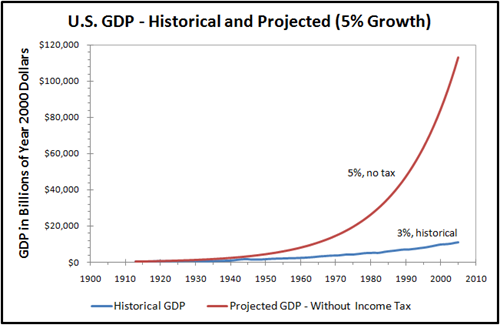
Let’s crunch some numbers. The average U.S. economic growth in GDP from 1913 to 2005 has been roughly 3% year to year. The next figure displays this in terms of Year 2000 Dollars (this allows us to take inflation into account). Recall that 1913 is the year the Sixteenth Amendment was ratified, which instituted the income tax.
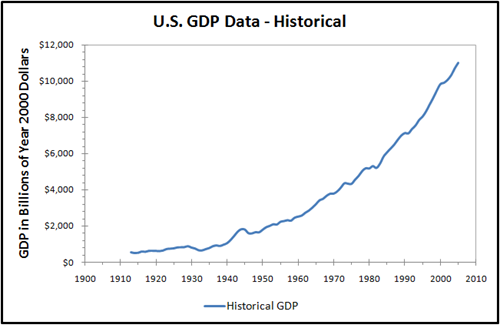
Upon inspection, one might say that this actually looks pretty good, 3% per year isn’t too shabby. However, substantial data that indicates that countries whose governments spend a greater percentage of wealth annually also experience diminished growth. I have scanned two graphs from Mary Ruwart’s Healing Our World (chapter 12) to help illustrate this. (Both are originally from Gwartney, Holcombe, and Lawson’s article entitled “The Scope of Government and the Wealth of Nations.”)

Note the trend in this first graph: the less a government spends its people’s wealth, the greater growth that nation will experience. This is correlated from hundreds of data points from various countries over time.
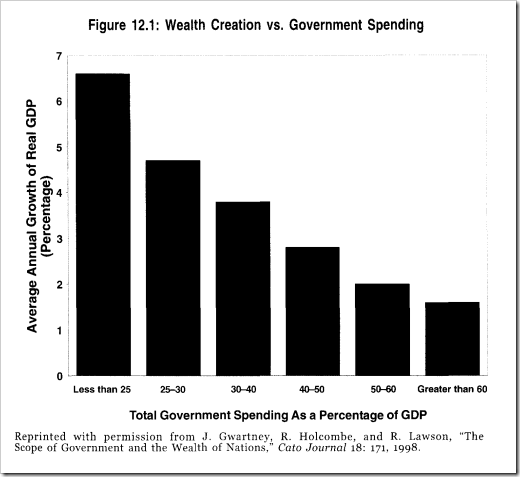
What is striking about this data is that as government spends ever less money, the rate of growth expands exponentially rather than linearly. In other words, a 10% reduction in government spending makes an even greater difference when moving from 25 to 15% total government spending (nearly 2% increase) than moving from 60% to 50% (about 0.25% increase).

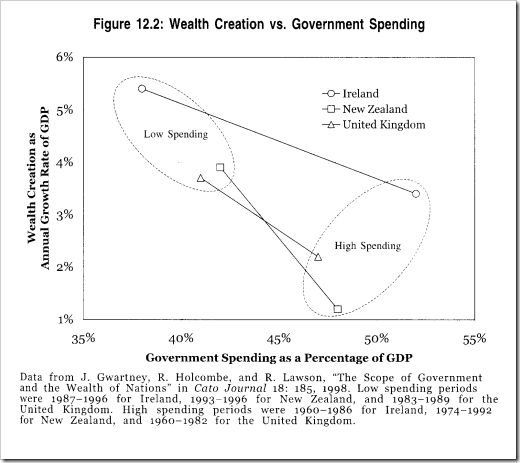
So, does this relationship hold in specific cases? In fact, it does. This next graph shows how Ireland, New Zealand, and the United Kingdom realized greater growth when they reduced government spending (data spans the years 1960 to 1996, see the caption).
wealth_creation

Each of these countries had governments that spent greater than 45% of their annual GDP. Thus, each country experienced low economic growth, between 1 and 4%. These are the only three developed countries that made significant reductions in government spending between 1960 and 1996. One can clearly see that when each country reduced spending, their economic growth shot up significantly. In the case of New Zealand, their growth rate expanded three times over! Less aggression expands wealth.

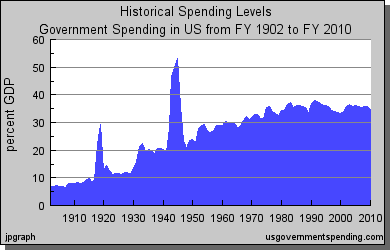
Think back to what you have learned in personal finance. Remember the concept of compound interest, that savings early on contributes to wealth expansion later? What is lost due to taxation is compounded over time. And when we consider what the United States government spends, the obvious conclusion is that we have missed an extraordinary opportunity. Over the last 100 years, the United States Federal Government has dramatically increased its consumption of annual GDP. You can readily see this in the next graph. Around 1915, the Feds spent only around 10%, and aside from the two gargantuan spikes (the World Wars), the general trend has been a steady increase to 35-40% of annual GDP. No wonder the economy is only growing at 3% in supposedly the most free nation on earth!
historical_spending

Now we are in the position to calculate the prosperity we have lost due to the income tax. It is actually a very simple calculation to make, if you make some simplifying assumptions.

In this case, I will assume no variation year to year in growth, and that the growth rate is 5% – only 2% above the current average rate. This is actually a conservative estimate when you think about it, because we would likely see upwards of 4-5% increase in annual growth if the income tax were eliminated as per the previously cited data. But for now, let’s call 5% the lower bound. Here’s what you get:
image

The difference between 3% and 5% growth is nothing short of startling. The conservative estimate is that we would likely be 8 to 10 times better off without the income tax, and that number would go up even further if the growth rate is greater. Can you imagine what could be done with this kind of prosperity? We are often amazed at what we can do and produce with modern science and technology and with the connectivity of the internet. But the difference we can anticipate with this much growth would likely dwarf what we see now. Most likely, by eliminating the aggression of taxation we would increase wealth creation somewhere between 3 and 18 times!

We have to realize that trade, the social mechanism of increasing our economic well-being, is a win-win proposition. By definition, when you and I agree to trade the fruits of our labor, we are implicitly agreeing that we are both better off by making the transaction. Conversely, government force is a lose-lose proposition. No one but the thief is made better off when coercion is exacted, and laws of nature do not change when the collector wears an IRS uniform and the spender is a government bureaucrat.

Those who argue that it is only through government that we will cure disease, help people out of poverty, and make this world a better place have not seen the data. Prosperity is what cleans up cities, gets people into jobs, and heals illness, and the government will always fail when it tries to intervene. Why? Because government only works by aggressing against its subjects, which unequivocally makes the subjects worse off.

How amazing that the world works in this way! We do not have to choose whether we will have either aggression and prosperity, or peace and poverty. Rather, peace and prosperity go hand in hand. Thank God, we live in a win-win world.

For now, however, we have little choice in the matter of taxes. We do the best we can to avoid as many taxes as possible and live in peace, because otherwise the strong arm of the State is waiting. Let us keep pushing back the State through persuading our fellow man of the evils of the State, trading peacefully, and working for positive change in our communities.

And the fight goes on…

To read more about the evils of taxation, check out my article series on LibertarianChristians.com, where this was originally posted.

Taxation Destroys Prosperity Read Post »

Scroll to Top