“Whatever the State saith is a lie; whatever it hath is a theft.”
~ Nietzsche
There is no shortage of reporting about GM CEO Ed Whitacre’s recent series of TV ads touting GM’s ostensible early repayment of federal loan money. Fox News, or as I like to refer to it, Faux News, is all over it. A website known as Video Café – Crooks and Liars has posted a very good review of the coverage, along with a YouTube video of the actual ad, for those who have not seen it.
Here’s what shocks me about the ad: Nothing.
It strikes me as pretty obvious that GM had to expect that someone would find out about their using loan money to repay loan money at some point. Did Whiteacre, clearly a man with intelligence, credentials, and connections, think nobody would put 2-and-2 together? Of course not. He didn’t care. He knows it doesn’t matter.
Indulge me as I recount one of my favorite jokes to begin illustrating why.
A burned-out executive moves to the hills to escape the rat race. He moves into an old cabin in what he believes to be sparsely-populated woods and starts his new life. He hopes to decompress and recharge and maybe re-connect with the fast-paced life he once knew at some later point.
One day, he hears a knock on his door. In walks a man wearing nothing but a pair of tattered overalls, some old work boots, and a broad smile. “Hey there, neighbor!” exclaims the man. “My name is Enoch and I’m your neighbor!”
Initially taken aback, the executive-turned-hillbilly gathers himself and extends his hand. “Pleased to meet you, Enoch. My name is, Bill Exeter. I just moved here from the Big City.” Bill figures it is about time he got more acquainted with his new environment anyway.
Enoch begins, “Well, Bill, I just wanted to invite you to a little gathering at my house on Friday.” What great timing! Bill can relax a little and meet some of his neighbors too. Sensing Bill might be a little uneasy about coming to a strange neighbor’s house, Enoch begins to pitch the party.
“Listen Bill, I need to warn you. My parties tend to get a little wild.” Bill smiles, feeling better about his new neighborhood. Enoch continues, “I can almost guarantee that there will be massive consumption of homebrew alcohol.”
Bill thinks, “Sounds good!” and responds, “Enoch, I can hold my liquor!”
Enoch continues, “Well then, I should probably also mention that this consumption of alcohol tends to make my guests a little bawdy. As a matter of fact, things got bad enough last time that there was wild sex during the party! I expect this one to be more of the same.”
Bill has been away from the rat race for long enough that the possibility of sex sounds good. “Well, Enoch, I’m no virgin, if I must say so myself.”
Enoch continues, “OK. I should also probably mention that fights tend to break out in the aftermath of many of my gatherings, especially after the sex.”
Bill, still happily pondering the possibility of sex, confidently says, “Hey Enoch, I can handle myself.”
Enoch ends with, “Excellent! I’ll look for you around 8:00 this Friday then.” Enoch turns to leave the house.
Just before Enoch closes the door behind himself, Bill yells, “Hey Enoch! What should I wear?”
Enoch shrugs his shoulders and says, “It don’t much matter. It’s just going to be the two of us.”
<Rim Shot>
The key point—the understanding that is manifested over and over in U.S. politics—is contained in that punch line: It doesn’t much matter anyway. GM received the TARP money, even though it is not a financial firm. One might argue that since GM used to own GMAC—its erstwhile lending mechanism—it qualifies as a financial firm. That strikes me as a stretch, but that does appear to be the partial mechanism GM used to get the cash. Certainly, the TARP money was specifically for financial firms. According to Wiki:
The Troubled Asset Relief Program, commonly referred to as TARP, is a program of the United States government to purchase assets and equity from financial institutions to strengthen its financial sector. It is the largest component of the government’s measures in 2008 to address the subprime mortgage crisis.
GM mismanaged and underperformed its way into a deep financial hole. It didn’t much matter. The responsibility for GM’s problems rested with GM. It didn’t much matter. In the aftermath of all that underperforming, GM had the gall to ask the government for some cash, a huge wad of cash, and acquired that money for both GM and GMAC.
The overwhelming majority of Americans did not think any firm should be bailed out. It didn’t much matter. Congress gave money ostensibly aimed at saving the financial sector from the subprime mortgage crisis to a troubled automobile manufacturer with a management and sales crisis.
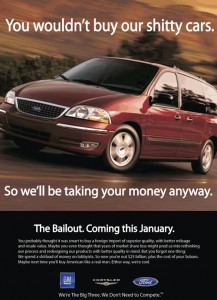
The American taxpayer was under no obligation to GM, its shareholders, or its employees. It didn’t much matter. GM got the cash. They have now paid back some of the early money with some of the later money, and have gone on TV to brag about it, despite the fact that such an obvious ruse should be found out. It didn’t much matter.
While some of this behavior initially upset me, looking back on it—particularly in context with the normal behavior of the State—I see that my anger was misplaced. The State generally and its agents in particular spew forth all manner of unmitigated, easily-identifiable equine feces on a routine basis. Think not? Here’s a recent sampling of talking points that have, inexplicably yet inexorably, fallen from the mouths of our leaders:
“They hate us for our freedoms.” (This phrase is generally uttered in regard to Islamic terrorists wanting to attack the U.S. Somehow the fact that other equally-free countries are not being similarly attacked gets obscured. Some have argued, persuasively, that such a designation as “free” for the U.S. is a little dicey anyway.)
“… too big to fail.” (What does this even mean? Can a firm be too small to fail as well? Can a firm be too big to succeed? Can a firm be too small to succeed? What does size have to do with the economic realities of losing money at business?)
“You’re either with us or you’re with the terrorists.” (That a reasonably-intelligent representative of the species Homo sapiens could say something this insipid and not be placed in a padded room—wearing a straitjacket and a mouth guard—speaks to the awesome power of patriotism, and stupidity, but maybe not in that order.)
“Illegal immigration represents a danger to the future of the U.S.” (The U.S. didn’t even have a comprehensive set of regulations on immigration until 1952. The Constitution doesn’t even mention immigration in those terms. Hell, damned-near everyone in the U.S. except for the people who were already here when America was “discovered” is an immigrant or descended from one anyway. Here’s my question: When does an immigrant become a visitor or a guest?)
“We fight them over there so we don’t have to fight them here.” (C’mon. Does anyone think the U.S. was in danger of being invaded by terrorists? Really? The truth of the matter is this: The U.S. military murders innocents abroad. Call me touchy, but that might upset me too.)
So Ed Whiteacre went on television, in an ad ironically entitled “Trust” and bragged about GM “putting people back to work” and how GM had “repaid their loan in full, 5 years ahead of schedule.” Don’t hate the playa! He was only doing what politicians do to the American public on a regular schedule: lie for specific gains, to an audience who wants to hear the lies, while knowing that even if the lie is found out, it won’t matter that much anyway. Consider: Since anyone who was seriously considering buying a GM car probably didn’t care about the bailout, what’s the downside of trying to rope in a few other suckers via bogus advertising? Moral hazard epitomized.
Is GM going to stop getting government bail-out money? Nope. Will any subsequent event preclude the next chronically mismanaged firm from getting a boatload of statist cash? Not likely. Will the skilled propagandists who do their best to lead rank-and-file Americans around by the nose change their tactics? Absolutely not.
It doesn’t much matter. It’s just them and our money—taken at gunpoint—anyway.
(Cross-posted at LRC.)