By
Robert Wicks
/ November 17, 2010 / 3 minutes of reading
Share
Radley Balko highlights the ridiculous case of a man arrested for interfering with police for filming them while they are on the job. Considering a passive observer, filming an arrest, to be “interfering” must be a special police corollary to the uncertainty principle that I missed in physics class. A friend asked the question, “how can one know what not to do?” This is a good question. If the laws on the books, and publicly clarified by the “authorities” are no shield, then what do we have?
As I mentioned before, police interactions with “civilians” are similar to the interactions between enslavers and slaves of the past. The rule on what can and cannot be done are set by the government official with whom you are interacting. Instead of rule by law, we have rule by overseer. Instead of viewing the police officer with whom you are speaking as a man as yourself, consider him a would-be slave master. He is has little reason to doubt his superiority to you. He has rights, and we have responsibilities.
How can it be otherwise? Whenever there is an asymmetry in recognized rights, there is great danger in interacting. During such interactions, the well-being of the oppressed is almost entirely dependent on the goodwill of the oppressor.
Consider the risks involved when an ordinary citizen has an interaction with the police. If a police officer is the violator, except in extremely egregious cases, nothing will happen to him. He will not be immediately fired after the accusation. A very bad outcome for a police officer will be him being fired, with no criminal record, and the ability to compete for a private sector job just like everyone else. Even in the case of him being prosecuted, he will likely be acquitted, and even if he is found guilty, he will be punished much less severely than an ordinary citizen.
On the other hand, consider the risk for a citizen. If a person with a regular job is arrested and held for several days, he may be fired from his job. An employer may not be able to afford to employ someone who is not at work, irrespective of the reason behind the absence. That means that even a misbehaving officer can ruin a person financially, even if that person is ultimately cleared of any wrongdoing. As I have mentioned before, this asymmetry is similar to that which existed between blacks and whites in the US (and especially the American South) prior to the middle of the 20th century. In such an environment, rather than being oppressive, segregation is actually desirable for the oppressed class. Unfortunately, the government does not permit mundanes, as the heroic William Norman Grigg calls ordinary citizens, to segregate themselves from the state.
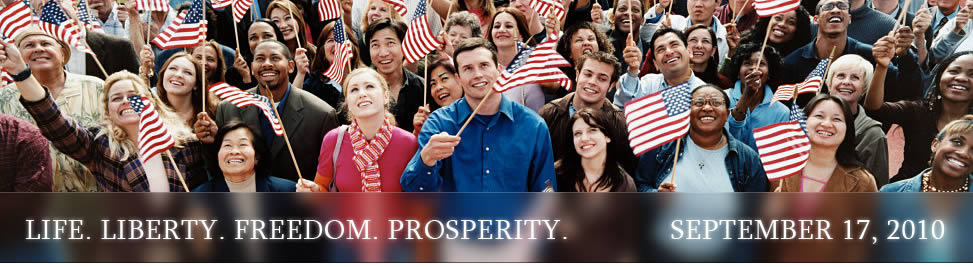
Today is the 223rd anniversary of the adoption of the modern American Constitution, on Sept. 17, 1787. Most Americans are too ignorant to even realize that this followed in the wake of the 1776 Declaration of Independence (on July 2, not July 4, 1776), and the Articles of Confederation adopted in 1781. Or to understand that the Bill of Rights was not adopted until 1791, two years after the Constitution was ratified (in their hysterical devotion to the flaccid Bill of Rights (see The Bad Bill of Rights) and ignorance about the limited powers scheme of the federal government, they would have to believe there were no rights in the two-year period between 1789 and 1791).
Flag-waving yahoos grin like idiots.
Yet, adopting the Official History and hagiography of our constructivist, utopian Founders, they worship the Constitution anyway, even though it was a coup d’état, even though slavery was permitted, even though it was an illegal, unnecessary, centralizing power play by politicians (see Rockwell on Hoppe on the Constitution as Expansion of Government Power), even though it arguably led to the Civil War, WWI, the collapse of western monarchies and the regressive replacement of traditionalist limited monarchy with socialized democracy, WWII, Naziism, Communism, the Holocaust, Nagasaki, Hiroshima, and the Cold War (see my When Did the Trouble Start?).
Ironically, today is officially decreed to be “ConstitutionDay” by the Congress, in an act that is itself unconstitutional since the Constitution does not authorize the Congress to establish any such quasi-religious institutions or observances. The very act of official worship of the Constitution is unconstitutional. How fitting.
Down with the Constitution. What a socialist, centralizing, utopian mistake. It is time for libertarians to stop glorifying early America, the Founders, the Constitution, etc., as proto-libertarian. All states are illegitimate, including America’s. As Lew Rockwell observed in stirring words in his article The Enemy Is Always the State:
Let me state this as plainly as possible. The enemy is the state. There are other enemies too, but none so fearsome, destructive, dangerous, or culturally and economically debilitating. No matter what other proximate enemy you can name — big business, unions, victim lobbies, foreign lobbies, medical cartels, religious groups, classes, city dwellers, farmers, left-wing professors, right-wing blue-collar workers, or even bankers and arms merchants — none are as horrible as the hydra known as the leviathan state. If you understand this point — and only this point — you can understand the core of libertarian strategy.
I offer to readers a term of my coinage: polidicy.
I construct it as “theodicy” was constructed, and I do so in the spirit of the copycat. A theodicy is a vindication of divine goodness in the context of the existence of evil. It is an important theological concept, and you will find theodicies embedded in most understandings of Providence, and nearly everyone who believes in a deity has some sort of theodicy in tow.
Polidicy, then, is a vindication of a state or government body in the context of its own obvious crimes. Most people who are loyal to some state and pretend to possess a moral sense, or conscience, have some polidicy in their head, some set of excuses for why the state’s many crimes do not amount to a moral case against the state as such, and how, even, the state can be said to be “basically good.”
By
Manuel Lora
/ July 8, 2010 / 2 minutes of reading
Share
Wild child Lindsay Lohan is apparently not a fan of staying out of trouble — nothing but private and public battles with family members, lovers, the media and, lately, the state (see here, here, here, here, here and here). In my opinion, her life is a mess. Yet I must come to her rescue — if only ideologically. You see, LiLo is a victim.
If you thought prohibition was repealed, think again. From minimum drinking age laws to laws that prohibit even parents, in some states, from responsibly introducing alcohol to kids, the state still manages to control not just the alcohol industry but those consuming it. Indeed, if you consume alcohol in places and times that the state deems “illegal,” you will be treated like cattle — literally. Indeed, Lohan has been in the past required to wear an alcohol monitoring bracelet. She has also been required to forcibly attend rehab (let’s see: a chain, involuntary migration — yep, sounds like a form of slavery to me) and comply with various others threats by the state.
The support for the war on drugs is sickening. From what I can tell, almost everyone has been bashing Lohan and praising the judge and the almighty legislation that makes these atrocities happen. Sure, if Lohan committed a real crime against someone else’s property or body, then she’d be guilty. However, the government’s gauntlet was thrown because she had the audacity to say no. There is no obligation to show up in court. LiLo’s record ought to be expunged. Set her free at once.