
Mimi & Eunice: Non-Commercial
Business, IP Law, Mimi & Eunice on IP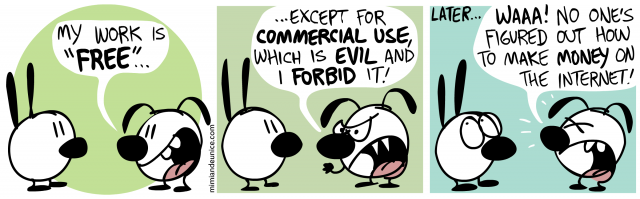
This is a syndicated post, which originally appeared at Mimi and Eunice » IP. View original post.
Mimi & Eunice: Non-Commercial Read Post »
This is a syndicated post, which originally appeared at Mimi and Eunice » IP. View original post.
Mimi & Eunice: Non-Commercial Read Post »
Understanding basic economics is crucial for all libertarians. No other field offers as clear and irrefutable a case for liberty. Indeed, statism draws much of its support from the public’s flawed understanding of economics. Even libertarians are occasionally led astray by flawed economic reasoning. A friend recently brought a book designed to combat such flaws to my attention: Geoffrey E. Wood’s Fifty Economic Fallacies Exposed.
…
eBook: Fifty Economic Fallacies Exposed Read Post »
Over this past summer I read William M. Johnston’s ‘The Austrian Mind‘. This scholarly work amply demonstrates Johnston’s vast erudition in the intellectual history of the Austrian-Hungarian empire during the Victorian era, or better yet, the Franz-Josephian era. I wanted to highlight a comparison that Johnston draws between the attitudes of that era’s medical establishments focus on diagnosis rather than treatment, with the classical liberal stance of non-intervention with market activities.
“The indifference to human life, which as late as 1900 afflicted the General Hospital, both contradicted and reinforced other Viennese attitudes… Disease comprised part of life: the task of doctors was not to eradicate it but merely to understand it. Refusal by nineteenth-century physicians to intervene in natural processes paralleled the reluctance of many Austrians to participate in politics. Likewise, the preference of Carl Menger and Ludwig von Mises for an unimpeded market seemed to corroborate the medical dictum, “The essential is to do no harm” (Primum est non nocere). -Pages 228-229
 The comparison is not entirely unfair, and certain qualities do correspond one another in a pleasing manner. For one, the quoted medical dictum is strikingly similar to Virgil’s oft-quoted aphorism “Tu ne cede malis sed contra audentior ito“, the motto by which Mises strived his life’s work.
‘Therapeutic nihilism’, as Johnston explained elsewhere, “[i]n medicine this phrase denoted systematic refusal to prescribe remedies for fear of perpetuating quack cures.” Later, he expounds on the unintentional side effect wrought by this passive attitude– “[i]t was a more cold-blooded self-mastery that impelled the Vienna anatomists to launch modern medicine. By sweeping away the post hoc, ergo propter hoc fallacies that had vitiated earlier therapy, they enabled the next generation to implement empirical pharmacology.”
It is eminently reasonable to compare this cold, medical attitude to the laissez-faire position that identified the policies of an interventionist state to be “quack cures”. Instead, the body politic would stop impeding the system’s endogenous recovery by simply refraining from coercive, property-invading measures, and thus allowing the market to work things out.
From the context I’m not entirely clear of Johnston’s intentions, and whether his distaste of the hands-off medical ethos carried over into the socio-political side of the analogy and so to be charitable I won’t presume this to be the case. Yet, someone less forgiving than I can read from these passages an insinuation that relying on the market’s “natural processes” is insufficient [i.e., the market is not perfectly self-regulating], and that it is therefore ripe for a dose of ’empirical pharmacology’ to improve things.
Now, unlike a doctor, an economist is a practitioner of a wertfrei science and as such would be overstepping the boundaries of his discipline if he were to proclaim a market to be “imperfect” or “inefficient”. Perfect/imperfect implies a comparison to some other situation, and whether or not that situation is to be preferred is strictly a matter of a subjective value judgment.
Yet, even if one were to concede the point that markets are sometimes flawed, this still would not support the notion that a central planner could or would be able to do a better job of making the market more perfect. If anything, Mises’s famous calculation argument showed that this would be an impossible task.
In conclusion, there is no reason to think that modern empirical economics is anything other than the same old quack medicine with a veneer of respectability.
Therapeutic Market Nihilism Read Post »
This is a syndicated post, which originally appeared at Mimi and Eunice » IP. View original post.
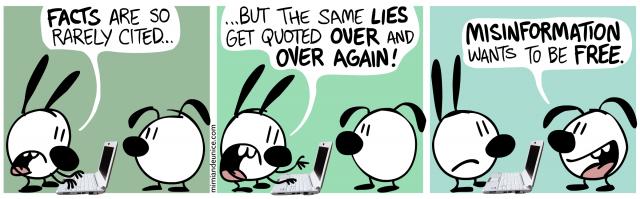
Mimi & Eunice: Misinformation Read Post »
Someone sent me a link to this paper yesterday.
Prof. Harris argues that skilled traders, who consistently profit, do so by taking money from people who trade for extrinsic reasons, to hedge risks, increase their savings, or simply to gamble for entertainment. He then points out an interesting implication:
If gamblers do indeed contribute to market quality in the long run by subsidizing information acquisition, an intriguing argument can be made about public lotteries. Lotteries would appear to compete with financial markets for gamblers willing to lose money. Lottery gamblers subsidize the state through their voluntary participation in a negative-sum game. Financial market gamblers subsidize productive information acquisition. Perhaps prices, and ultimately economic production, would be more efficient if gamblers gambled exclusively in the financial markets.
So there you have it — state lotteries make us worse off by wasting gambling money that would otherwise be productively spent.
How State Lotteries Make Markets Less Efficient Read Post »