Article: Intellectual Freedom and Learning Versus Patent and Copyright

Articles, IP Law
Share

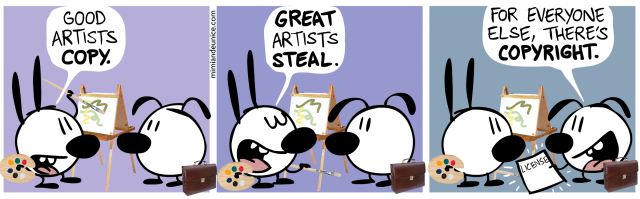
In my various publications and speeches about intellectual property (IP), I’ve approached it from a variety of angles. In this article, I consider the role of information and learning, and the role of property rights, in human action. I use a praxeological analysis to show that human action employs scarce resources or means, but that action is guided by non-scarce ideas and knowledge. Property rights are recognized in means because they are scarce; but ideas are not scarce things: they are infinitely reproducible.  The growing body of knowledge is a boon to mankind. Property rights are needed for scarce means so that they can be peacefully and productively used in action; property rights in ideas restrict, impair, and imped learning and the use of information to guide one’s actions. Copying information and ideas is not stealing.  Learning is not stealing.  Using information is not trespass. In this article, I urge young libertarians to stay on the vanguard of intellectual freedom, and to fight the shackles of patent and copyright.

Mises Academy: Stephan Kinsella teaches Libertarian Legal TheoryThis article is based on my speech of Nov. 6, 2010, at the 2010 Students for Liberty Texas Regional Conference, University of Texas, Austin (audio and video versions may be found here). A previous version was published today under the same title in Economic Notes No. 113 (Libertarian Alliance, 2011).

(Incidentally, my 6-week Mises Academy course “Libertarian Legal Theory: Property, Conflict, and Society” starts at the end of this month (Jan. 31-Mar. 11, 2011). I describe it in my article “Introduction to Libertarian Legal Theory,” Mises Daily (Jan. 3, 2011).)

Read the Full Article by Stephan Kinsella

Afterwards, discuss it below.

Article: Intellectual Freedom and Learning Versus Patent and Copyright Read Post »

Progressive Egalitarians Should Be Anti-IP

(Austrian) Economics, Business, IP Law, Libertarian Theory, Pop Culture, The Left, Vulgar Politics
Share

The Obama Administration insists that “‘Piracy is flat, unadulterated theft,’ and it should be dealt with accordingly.” Nonsense, of course. Only scarce goods can be property and therefore only scarce goods can be stolen. Ideas or information patterns are nonscarce goods. If I take your bicycle, you don’t have it anymore. If I copy your idea, now we both have it. Copying, i.e., piracy, is not theft.

As the Left is wont to do in lieu of sound argument, US Commerce Secretary Gary Locke recently related what is meant to be a heartrending story:

Recently, I’ve had a chance to read letters from award winning writers and artists whose livelihoods have been destroyed by music piracy. One letter that stuck out for me was a guy who said the songwriting royalties he had depended on to ‘be a golden parachute to fund his retirement had turned out to be a lead balloon.’ This just isn’t right.

My first immediate thought was why isn’t it right? Shouldn’t a progressive egalitarian’s own values lead him to be against intellectual property?

Progressive Egalitarians Should Be Anti-IP Read Post »

How to Mirror a Censored WordPress Blog

Anti-Statism, Police Statism, Technology
Share

A couple of days ago David mentioned that the Mises Institute providing its entire online media and literature library as a set of free torrents can be seen as part of a distributed or grassroots intellectual guerrilla resistance against the state.

This is just one aspect of the Mises Institute’s effort to be completely open source. All of the intellectual eggs of the Austro-Libertarian movement are no longer being kept in one basket. The more people who seed those torrents, the easier the burden on the Mises Institute. But more importantly, should statist or natural disaster strike, the world won’t lose the vast wealth of information hosted by the Mises Institute. Indeed, not only will the information not be lost, but there will be no downtime in its worldwide online distribution. Should states decide to actively move against us, they’ll be in for one hell of a game of ‘whack-a-mole’. They’ll face the same problems the RIAA, Hollywood, and others are facing in their War on Piracy Copying.

Austro-Libertarianism has gone viral, folks.

All this is to set the context for another example of open source anti-state resistance that I recently discovered.

WordPress is an open source website and blogging platform. It’s an easy to use, yet powerful, tool for getting our ideas online where people around the world can access them. It’s free, as in speech and beer. This site is powered by it. My site is powered by it. The Mises Institute’s site is powered by it.

But some countries like China and Australia censor the internet, blocking access to unapproved sites like YouTube and Twitter, filtering or blocking or shutting down or otherwise regulating websites and blogs.

There are ways to get around this censorship, however. Here’s one: The good folks at Global Voices Advocacy, an organization defending free speech online, have heroically created a guide to mirroring a censored WordPress blog. It’s covered by a Creative Commons Attribution 3.0 license, just like The Libertarian Standard. Get it. Share it. Even if you don’t need it yet, someday you might. Others already do. In the spirit of the Mises Institute’s torrented online library, we’re hosting the guide here as well.

Update: Via The Register, Google has put together an online interactive Transparency Report detailing how governments around the world are censoring the internet and Google services. Google also provides a Government Requests map detailing government “requests” that Google provide data on its users.

~*~

Cross-posted at Is-Ought GAP.

How to Mirror a Censored WordPress Blog Read Post »

Mises.org Available as a Torrent Download!

Anti-Statism, Education, Technology
Share

The Ludwig von Mises Institute has issued the second release of all of the content on their website as torrent files. This means that you can download all of the content available on Mises.org (as of June 15, 2010) by downloading various torrent files and opening them up with your torrent client (e.g., uTorrent, Vuze, or Transmission). This is great both for those who read Mises.org or listen to the media from that website. Thank you David Veksler, Jeffrey Tucker, and everyone else at the Mises Institute who made this possible!

The benefits of this are enormous. All of the information, wisdom, and knowledge on Mises.org is available for $0 to the general public, via Torrent download.1 This directly contradicts what Statists would have us believe is the nature of the free-market — people exploiting each other to succeed. How then do they explain the Mises Institute? The Mises Institute is a truly philanthropic organization, which helps thousands through education: education through peace and persuasion, not “education” at the barrel of a gun.

This will help the Mises Institute, its patrons, and Mises.org readers in numerous ways. Instead of having to navigate to the page or Media section of Mises.org and use browser plugins or spiders, those with a thirst for knowledge and understanding of economics and the free market can simply download everything they want through one torrent file. It also saves the Mises Institute tons of bandwidth, because people downloading torrents simultaneously share in the upload burden by seeding the file (if you download the file, please try to seed until your upload:download ratio is 1.2, this is normal Torrent etiquette). There is a dynamic carryover effect to torrenting: one person might only seed for a few weeks, but dozens of people who leeched from him might seed for a few weeks as well. Thus, there is a kind of digital compounding or interest-effect. Contrary to what you might think — and contrary to what advocates of intellectual property and particularly copyrights would tell you — this will not hurt Mises.org sales of books, but rather boost them, as explained by Jeffrey Tucker.

We can also think of this as a kind of grassroots, guerrilla intellectual resistance. The entire Mises.org media, book, journal, and PDF library will be distributed to thousands of hard drives around the world, will be shared by thousands of people. It can’t shut it down simply by shutting down the Mises Institute anymore. This has two benefits: (1) People can access Mises.org content even if the Mises.org website is down, provided they have the torrents; (2) If the US government wanted to shut down Mises.org, it would still face the distributed world-wide torrents, which would be almost impossible to shut down by a central authority.

So for those of you who are interested, please download: Help Mises.org and yourself at the same time. Download the books, pdfs, journal articles, videos, and mp3 files; listen to, watch, or read them; enjoy the overwhelming amount of knowledge you can have at your fingertips. This is truly a great example of Austrian economics at work: both parties clearly gain something from the interaction ex ante and almost certainly ex post too!

The Mises.org blog announcement:

Mises Torrents 2.0 Available

It’s been about a year early since the first public release of torrents containing all the document and media content on Mises.org. The Mises Institute staff adds new content frequently, so it is time for version 2.0.  Here are the 2010 torrents: Mises Media (132 GB), Books (8.6GB), Journals (4.1 GB), PDFs (324 MB), and ReasonPapers (1.4 GB).

For more files and details see the original announcement.  If you are new to BitTorrent, install the uTorrent client, open the links above, and you’ll be on your way.

If you downloaded an earlier version of this content, please do not re-download everything.  In both uTorrent and Vuze, you can get just the missing files.  In uTorrent,  start the download and let it create the placeholder directory, then stop it.  Overwrite the placeholder directory with your existing files, then “Force Re-Check.”  You can do the same in Vuze –  just enable the option to “Truncate existing files that are too large” under Options->Files.  Then resume.

By my best calculations, we seeded last year’s torrents to thousands of computers worldwide and served over 4 terabytes from our servers alone.  Please help us spread the word and make this release even bigger.

Join the discussion and post a comment


  1. I would like to thank Manuel Lora, Michael Barnett, and Geoffrey A. Plauche for their helpful insights and comments on this blog post. 

Mises.org Available as a Torrent Download! Read Post »

Scroll to Top