
Mimi & Eunice: Just Some Old Junk I Don’t Want
IP Law, Mimi & Eunice on IP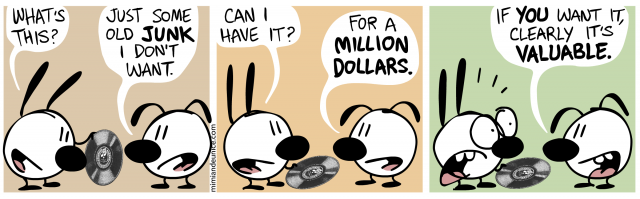
Mimi & Eunice: Just Some Old Junk I Don’t Want Read Post »
This post is excerpted and adapted from the concluding chapter of my dissertation, wherein I addressed two related objections to libertarianism in general and to my account of Aristotelian liberalism in particular: utopianism and gnosticism, the latter being sort of a theological version of the former. Does the theory of virtue ethics and natural rights described in my dissertation represent an impossibly high standard of ethical excellence? On a related note, is it foolishly impractical given the current shoddy state of the world? And is the ideal society suggested by my nonstatist conception of politics and severe critique of the state an impossible goal? Even if it is achieved, will it ring in a perfect world of peace, love, and happiness without violence, misfortune, and suffering? Naturally, my short answer to all of these questions is “No.”
First, I wish to answer the charge of gnosticism that might be leveled by followers of the political philosopher Eric Voegelin. Voegelin is very popular in certain conservative and communitarian circles, particularly those averse to philosophical systems and principled, as opposed to practical or pragmatic or “realist,” politics.1 I should know; I studied political science and philosophy at Louisiana State University where Voegelin had been a prominent professor. Indeed, LSU is home to the Eric Voegelin Institute for American Renaissance Studies. I was introduced to the work of Voegelin by Professor Ellis Sandoz, a student of Voegelin himself and the director of the institute.
Gnosticism, as Voegelin uses the term, essentially means a “type of thinking that claims absolute cognitive mastery of reality. Relying as it does on a claim to gnosis, gnosticism considers its knowledge not subject to criticism. As a religious or quasi-religious movement, gnosticism may take transcendentalizing (as in the case of the Gnostic movement of late antiquity) or immanentizing forms (as in the case of Marxism).” Now, does that sound like it applies to libertarianism, much less Austro-libertarianism? Rather, it makes me think in particular of the constructivist rationalism, criticized incisively by Friedrich Hayek, that arose out of the Enlightenment and pervades various forms of modern statism.
In his political analysis, Voegelin uses the term to refer to a certain kind of mass movement, particularly mass political movements. As examples, he gives “progressivism, positivism, Marxism, psychoanalysis, communism, fascism, and national socialism.”2 In his view, the consequences wrought by these movements have been disastrous. With few and only partial qualifications, I do not disagree. What makes them gnostic are certain similar characteristics they share with the original Gnostic religious movement of antiquity. Before listing the main characteristics, it first bears pointing out that even the broad libertarian movement as a whole might not yet qualify as a mass movement. However, as Voegelin points out, “none of the movements cited began as a mass movement; all derived from intellectuals and small groups,”3 so contemporary libertarianism and Aristotelian liberalism are not off the hook yet! With regard to the following list, Voegelin cautions that the six characteristics, “taken together, reveal the nature of the gnostic attitude.”4
…
Is Libertarianism a Gnostic or Utopian Political Movement?Read More »
In Science, Politics, and Gnosticism, Voegelin writes: “Gnosis desires dominion over being; in order to seize control of being the gnostic constructs his system. The building of systems is a gnostic form of reasoning, not a philosophical one” (p. 32). It can never be an attempt to understand being at it is? I think Voegelin makes a spurious generalization here. When one reads further, it becomes apparent that he makes this mistake at least in part because he believes in a Christian Beyond that is not amenable to (human) reason. ↩
Eric Voegelin, Science, Politics, and Gnosticism (Wilmington, DE: ISI Books, 1968 [2004]) p. 61. See also, Eric Voegelin, The New Science of Politics: An Introduction (Chicago & London: University of Chicago Press, 1952 [1987]). ↩
Ibid., p. 62 ↩
Ibid., p. 64; emphasis mine. ↩
Is Libertarianism a Gnostic or Utopian Political Movement? Read Post »
But what we in politics wish to know is whether Mr. Minister X understands his business, whether he has initiative, whether he is informed, whether he steals more than is absolutely necessary, whether he lies more than is publicly beneficial, and so on …
— Eric Voegelin
In other words, just tweak a few things here and there and make sure you get the right politician (read: less evil than most) into office. Then the state will work fine — ordered liberty will be achieved; society and market will flourish; Leviathan will be indefinitely averted.
Paradox: How to achieve this when statist political systems favor the unscrupulous, incentivize their seeking and maintaining office and increasing their power, steadily erode what moral fiber they may have, and make useless or harmful to their political careers any truly important knowledge or skills (such as of economics or how to actually be productive in society).
…
Idealistic Politics Read Post »
A few years ago in honor of Arthur C. Clarke’s then-recent birthday, I wrote on my own blog that he must never have read Ludwig von Mises and Murray Rothbard,
because according to this quote cited by Gregory Benford in his happy-birthday letter in Locus Magazine (January 2008), he claims that “there are some general laws governing scientific extrapolation, as there are not (pace Marx) in the case of politics and economics.” Well, far be it from me to disagree that Marx was wrong about a lot of things, but Clarke is wrong here. Sir Clarke, you may be 90 years old now, and happy birthday by the way, but it’s never too late to acquire a firm grasp of sound economic theory.
As disappointing as it is, it’s not surprising that he had a natural-scientistic bias against economics. Sadly, he died only a few months after my post.
In a more recent article in the Sri Lanka Guardian, more of Clarke’s economic ignorance is on display:
While researching for this article I came across a searing indictment by Clarke on the American capitalist system. After observing that the structure of American society may be unfitted for the effort that the conquest of space demands he continued, “No nation can afford to divert its ablest men into essentially non-creative and occasionally parasitic occupations such as law, insurance and banking”. He also referred to a photograph in Life Magazine showing 7,000 engineers massed behind a new model car they had produced as ‘a horrifying social document’. He was appalled by the squandering of technical manpower it represented. All this indeed makes one wonder whether he really was a closet socialist.
…
Arthur C. Clarke vs. Economics and Capitalism Read Post »
Jeremy B. White of the NY Observer writes:
“City Council Member Brad Lander introduced a bill today that would require banks to help pay for the upkeep of foreclosed homes by posting bonds with a minimum value of $10,000.”
 What he failed to write was that if this bill were to pass, new mortgage applications would either require a $10,000 fee to cover for foreclosure contingencies, or more likely just include a risk premium for that $10,000 bond. Even if the bill would ban sticking the potential mortgager with that bill, it would compel banks to be even stricter in their lending standards than they would have been otherwise, thus cutting off otherwise qualified applicants from buying homes, foreclosed or otherwise.
In either scenario, the tendency will be to have empty foreclosed homes sitting longer in unkempt vacancy than in the counterfactual situation in which the government didn’t meddle as much.
Don’t you love well-intentioned, yet clueless legislators?
Passing a BillMeNow For Later Read Post »